






Looking at the economy in 2026, hiring German-speaking talents has become a strategic priority for many international companies operating in Europe.
Whether the goal is to expand into the DACH market, strengthen multilingual customer support teams, or even build specialized international departments, German speakers remain among the most in demand candidates in the European labour market.
However, recruiters need to understand that attracting and retaining German professionals requires more than simply posting a job advertisement in German. They have to adapt to the current economic context, work culture, and expectations of candidates from Germany.
The 10 steps that you will find in this following article could serve as a useful handbook for employers on how to successfully attract, recruit, and retain German-speaking talent.
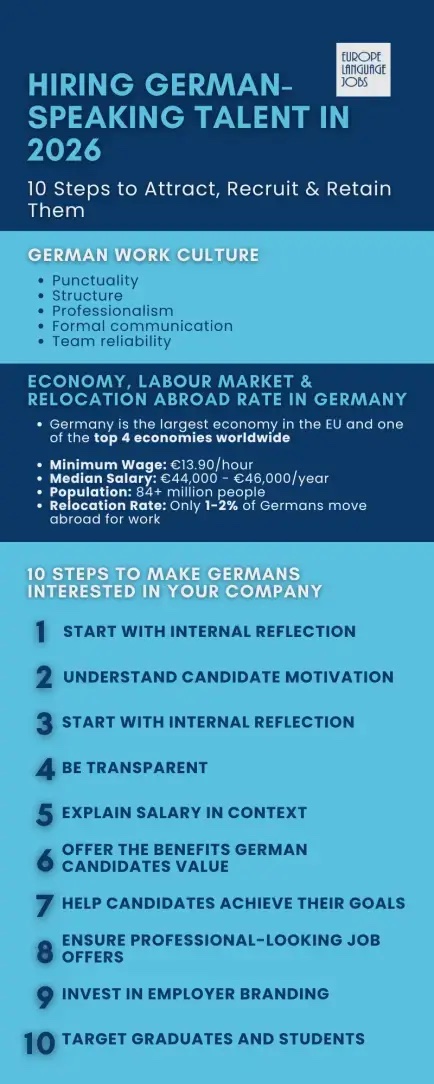
Understanding German work culture
Before designing your hiring strategy and starting the recruitment process, it is essential to understand the cultural values that shape the professional mindset of German candidates.
As you may have heard, German work culture is widely associated with several key principles:
-
Punctuality - deadlines and schedules are taken very seriously,
-
Hierarchy and structure - clear roles and responsibilities are expected from everyone in the team,
-
Professionalism - work and personal life are typically kept separate,
-
Formal communication - especially in professional environments,
-
Teamwork and reliability - colleagues depend on each other’s consistency.
Consequently, these characteristics of the German work environment strongly influence what German candidates expect from employers and the workplace, no matter the location in Europe.
German job market and economy in 2026
Another aspect to be considered by recruiters before elaborating their hiring strategy for German native candidates is the current economic status of their country.
Germany continues to be the largest economy in Europe and among the four largest economies globally, making the German labour market one of the most stable ones in Europe.
That is why getting a perspective on all salary benchmarks and employment conditions is essential when designing competitive job offers.
Wage variations
Employers aiming to recruit German professionals should get to know the basic data of Germany’s economy. Here, we give you a quick overview of the economic labour situation in 2026:
-
Germany’s permitted minimum wage increased to €13.90 per hour in 2026 and is expected to continue progressive adjustments over the following few years.
-
Across Germany, the gross median salary in 2026 varies between €44,000 and €46,000, depending not only on industry and gender gap, but also on regional differences in Germany.
-
Speaking of regional salary differences, here is how different areas of Germany get paid:
-
higher salaries in the West of Germany: Munich, Frankfurt, Stuttgart, Cologne, Düsseldorf,
-
a little bit lower salaries in the East of Germany: Leipzig, Dresden, Frankfurt.
Salary spectrum for different industries
After giving recruiters a slight overview of the basic statistics of Germany’s economics since the start of 2026, here is a list of all highest and lowest paid occupation industries of Germany’s job market:
-
Highest paid industries:
-
Banking - €70,250
-
Aerospace - €68,000
-
Insurance - €66,500
-
Pharmaceutical industry - €66,250
-
Science and research - €66,250
-
Lowest paid industries:
-
Hotels, hospitality and catering - €45,500
-
Agriculture, forestry and fisheries, horticulture - €47,250
-
Leisure, tourism, culture and sports - €49,750
-
Skilled trades - €49,750
-
Transport and logistics - €50,000
Knowing the approximate median salary range for different industries in the candidate’s country is an essential step of the employer's preparation for the hiring process. Hiring managers need to know how to adapt the expectations of the new professionals coming from Germany to the company’s financial spectrum.
Labour demand - who is currently needed?
Speaking of recruiting German speakers in 2026, it is also necessary for recruiters to comprehend that strong economy of Germany contributes to low unemployment and strong labour demand, making international recruitment particularly competitive.
What is more - the job market continues to face significant labour shortages in several sectors. Here are some of the currently high-demand industries in Germany:
-
Technology and IT
-
Healthcare and Life Sciences
-
Engineering and Manufacturing
-
Green Energy and Sustainability
-
Finance and Fintech
-
E-Commerce and Digital Marketing
-
Skilled Trades and Logistics
Employment and unemployment trends
As mentioned already, Germany’s economic state remains one of the most stable ones in Europe. Therefore, it won’t come as a surprise to all recruiting teams that it ranks as well among the top 5 lowest unemployment rates on the continent.
Furthermore, the youth unemployment also remains relatively low compared with many EU countries, leading to the conclusion that it should be ‘relatively easy’ to find a job in Germany…but not for everybody.
There is currently still a surplus of qualified professional-level jobseekers. Therefore, HR teams should be able to find suitable candidates to fill in vacancies in these sectors.
The question is how to do it in the correct way?
German professionals moving abroad
Germany has a population of over 84 million people, making it the most populous country in the European Union. Still, there are native Germans that are searching for their happiness in other countries.
How many of them are moving outside of Germany?
Considering the current population of Germany, only a relatively small share of German professionals relocate abroad for work.
It is estimated that roughly 1-2% of the workforce moves to another European country, meaning competition between employers targeting German talent is particularly intense.
That is why recruiters need to stand out in this fierce job market situation when trying to attract german speakers.
What makes Germans relocate abroad?
German professionals typically relocate for two main reasons:
-
Career and Financial Opportunities - and that's when they choose:
-
Austria
-
Belgium
-
Netherlands
-
Sweden
-
Lifestyle and Quality of Life - and that's when they choose:
-
-
Spain
-
France
-
Italy
-
Portugal
-
10 steps to attract, recruit and retain German speakers
Here is how you should build your hiring strategy step by step, in order to attract german speakers to your team:
1. Start with internal reflection
Before launching any recruitment campaign, companies should first assess what they are already doing internally in order to try and improve the employee experience.
Attracting German-speaking candidates is not only about publishing a job ad in the right place. It rather starts with reviewing the foundations: the HR strategy, the employer branding positioning, and the actual day-to-day experience employees have within the company’s environment.
Recruiters should also stay up to date with current HR trends and adapt their practices accordingly. German-speaking candidates tend to respond well to employers that appear structured, modern, and intentional, as it is observed through their work habits.
This makes it essential to understand the target candidate profile in detail, including what motivates them, what concerns them, and what they expect from an international employer.
2.Understand candidate motivation
HR specialists should know that a successful hiring strategy depends on correctly identifying why German-speaking candidates would consider relocating in the first place. Not all of them move abroad for the same reason, and this should directly influence how the opportunity is communicated and presented.
If a candidate is considering relocation because they want to develop their career and earn more, then the job offer and hiring strategy should clearly emphasize career growth, long-term progression, and financial logic.
If, on the other hand, the candidate is mostly motivated by the desire of a lifestyle change, then the offer should highlight quality-of-life factors, the destination country’s advantages, and the experience of living abroad.
In other words, the message communicated by the recruiter should match the motivation of the candidate. Recruiters who fail to identify this often end up promoting the wrong aspects of the role to the wrong audience.
3.Be transparent
It might occur as too stereotypical to say that transparency remains one of the most important conversion factors in recruitment, however it is still true.
Job offers that include salaries tend to perform better than those that do not. Following the same logic, offers that combine salary information with attractive benefits usually perform even better.
For German-speaking candidates in particular, transparency builds trust. It signals professionalism, seriousness, and respect for the candidate’s time, which as mentioned above, are deeply valued by Germans. A vague job description may generate impressions, but it is much less likely to generate quality applications. This is why clarity around compensation, expectations, and working conditions should be treated as a strategic advantage rather than a risk.
4.Explain salary in context
When recruiting German speakers abroad, salary should never be communicated in isolation. If your company as a recruiter cannot offer a salary as high as those commonly available in Germany, but the cost of living in your country is significantly lower, this needs to be explained clearly to the candidate.
Recruiters should provide context and help candidates understand the practical value of the job offer. A bullet point, such as “salary adjusted to local cost of living”, can already help, but it is often even more effective to include one or two sentences about the city or country, the financial benefits of living there, and the difference in everyday expenses.
What may seem obvious to the employer may not be obvious to the candidate, and that is the reason why you need to put yourself in the jobseeker position. A lower nominal salary can still represent a strong opportunity if the overall quality of life and affordability are communicated properly in order to attract the German professional.
5.Offer the benefits German candidates value
As discussed in this article already, the salary alone is not enough to make an offer competitive in the 2026 job market.
In fact, salary should not be presented as a benefit, but as the baseline. What often influences decision-making more strongly in candidates are the additional conditions attached to the role.
German-speaking jobseekers tend to value benefits that make relocation safer, life abroad easier and more enjoyable, but as well work more sustainable. These often include health insurance, relocation packages, support with documentation, clear boundaries between work and private life, no overtime or clearly paid overtime, flexible work models, development incentives, corporate perks, such as sports cards, and mental health support, etc.
However, recruiters still should keep in mind that a strong benefits package should not feel generic. It should rather be clearly aligned with what the candidate is likely to value when moving abroad and adapting to a new environment.
6.Help candidates achieve their goals
A really important detail when communicating the role that HR specialists should be careful about, is to not confuse vague promises with real benefits.
Saying that a candidate will have the “possibility to climb the corporate ladder” is not a concrete value proposition. Telling them that the company offers mentorship programs, access to free courses, structured training, and clear development opportunities is far more meaningful.
The same logic applies to lifestyle messaging. Claiming that a country has “300 sunny days per year” may sound attractive, but it is still too abstract on its own. However, if the employer explains how candidates can actually enjoy that lifestyle through after-work activities, clubs, social initiatives, or outdoor experiences, then the message becomes much more tangible and persuasive, attracting the candidate.
The key principle here is simple: employers should not only sell the opportunity, but also demonstrate how they will help candidates achieve the goals that motivated them to relocate in the first place.
7.Ensure professional-looking job offers
Employers have to always be prepared with a good-looking presentation, as first impressions matter a lot. Even a strong role can lose credibility if the job ad looks careless or poorly written. Recruiters should review every job offer carefully and check it multiple times for spelling, grammar, and clarity.
Job descriptions with visible errors tend to receive fewer applications because candidates often perceive them as unprofessional, unreliable, or even suspicious, as a scam.
This is especially relevant when targeting German-speaking candidates, who often expect a high level of structure and professionalism from the first interaction with an employer.
A professional-looking job ad does not only improve trust, but it also strengthens employer reputation and increases the likelihood of attracting, and afterwards recruiting serious applications.
8.Invest in employer branding
Employer branding is a long-term investment when it comes to recruiters, but it plays a major role in whether candidates decide to trust a company or not.
Before applying, many German speakers will most certainly check the employer’s online presence, social media channels, and overall digital credibility, to make sure that this job ad is not a scam.
This means companies should make sure they have an established and active online presence. Their social media profiles should feel real, up to date, and consistent with the values they communicate in their job offers. It is important to show the company’s internal culture, the people behind the brand, and the initiatives that make the workplace stand out.
The goal is not only to post content for visibility, but to make the employer feel authentic. Candidates want to see that the company is active, credible, and trustworthy. A strong employer brand makes them far more likely to engage with the career opportunity.
9.Target graduates and students
Another important segment to consider when hiring new talent is graduates and students. German universities often maintain close relationships with employers and offer strong domestic career opportunities.
As a result, the competition is bigger as international employers need to give young candidates a compelling reason to consider moving abroad.
To attract this audience, companies should frame the opportunity as more than just a job. It should be presented as well as an adventure, an employability boost, and a meaningful international experience.
For younger candidates, the idea of building a career abroad can be highly attractive, if it is positioned as both professionally valuable and personally enriching. Therefore, the focus should be on benefits, learning opportunities, exposure, and the added value of international experience early in the career path.
10.Consider the 50+ talent segment
Last but not least, recruiters across Europe should avoid overlooking the 50+ talent segment. This group is often underestimated, yet it can offer significant value to employers seeking stability and experience.
Candidates in this age group are often highly reliable, easy to work with, and bring extensive professional knowledge. They also tend to stay longer in one workplace, which makes them especially attractive for HR teams from a retention perspective.
Many of them are motivated by lifestyle change rather than career acceleration. They often value private health insurance, development opportunities, outdoor activities, and a balanced way of living. For employers, this means the 50+ segment can represent a strong and often underused source of long-term talent.
Standing out as an HR is no longer optional - it is essential
After all, attracting, recruiting and retaining German-speaking candidates requires more than simply offering a job abroad.
Recruiters need a clear understanding of their motivations, expectations, and professional culture in order to position job opportunities in an effective way.
By combining transparency, competitive benefits, strong employer branding, and a well-structured recruitment strategy, companies can significantly improve their chances of standing out in a highly competitive talent market.
At the end, the employers who succeed are those who communicate real value and build trust from the very first interaction with the candidate, and not those just posting a job description and hoping for the best.