






Most job interview tips focus on helping candidates perform better.
But in today’s hiring landscape, we will approach the job interview from the HR’s perspective.
Gen Z changed the approach to job interviews. And yet, many interview processes still rely on the same expectations, the same interview questions, and the same evaluation criteria as before. And this is where everybody can feel disconnected.
Gen Z candidates are not unprepared or difficult to assess. They are simply responding differently to interview questions that reflect how they think about work, growth, or motivation. For employers, this creates a challenge, not because candidates are harder to evaluate, but because the signals you’re looking for might no longer be the right ones.
When you’re hiring young talent, understanding how Gen Z approaches interviews is becoming essential in today’s evolving job market. If you want your job interviews to take a different shape when hiring Gen Z, let’s start with rethinking what to expect from the very beginning!
Why Traditional Interview Questions No Longer Work for Gen Z
Most interview questions that are still used today were designed for a different hiring context: one where stability, hierarchy, and long-term commitment were the default expectations and requirements.
Gen Z candidates approach work differently, and this creates a gap between what employers ask and what candidates are actually prepared to answer. Many interview questions are still based on assumptions that don’t fully reflect how Gen Z approaches work.
The structure hasn’t changed much, but surprise: candidate expectations have!
Here are 3 common interview questions that still appear in most of the hiring interviews, but that often lead to very different answers than employers expect:
-
“Where do you see yourself in 10 years?”
Traditionally, this question is meant to assess ambition, stability, and long-term commitment. By asking this question, recruiters wanted to assess candidate's motivation to stay in the workplace for a longer period of time. It was expected from candidates to include the company in their personal plans for the future.
But… for many Gen Z candidates, the idea of a fixed 10-year plan doesn’t feel realistic. Instead of outlining a clear career path within one company, they are more likely to talk about gaining experience, developing skills, or staying open to opportunities.
For majority of Gen Z, the workplace is an extension of their life and they seek to find the perfect work environment that will match their values and beliefs. What is more, young members of the workforce carry very strong values and beliefs, one of them being that they care a lot about social issues and the planet. Meaning, they will rather accept an offer at a company that has a very good CSR, rather than one that focuses only on profit and treats its employees like numbers. Moreover, many member of Gen Z will make sure to ask questions in order to understand your position towards this kind of topics. From “Where do you see yourself in 10 years?” , be prepared because the next question might be directed back at you! For example: “Can you share an example of a company decision that prioritized values over short-term profit?” (and we love Gen Z for that)
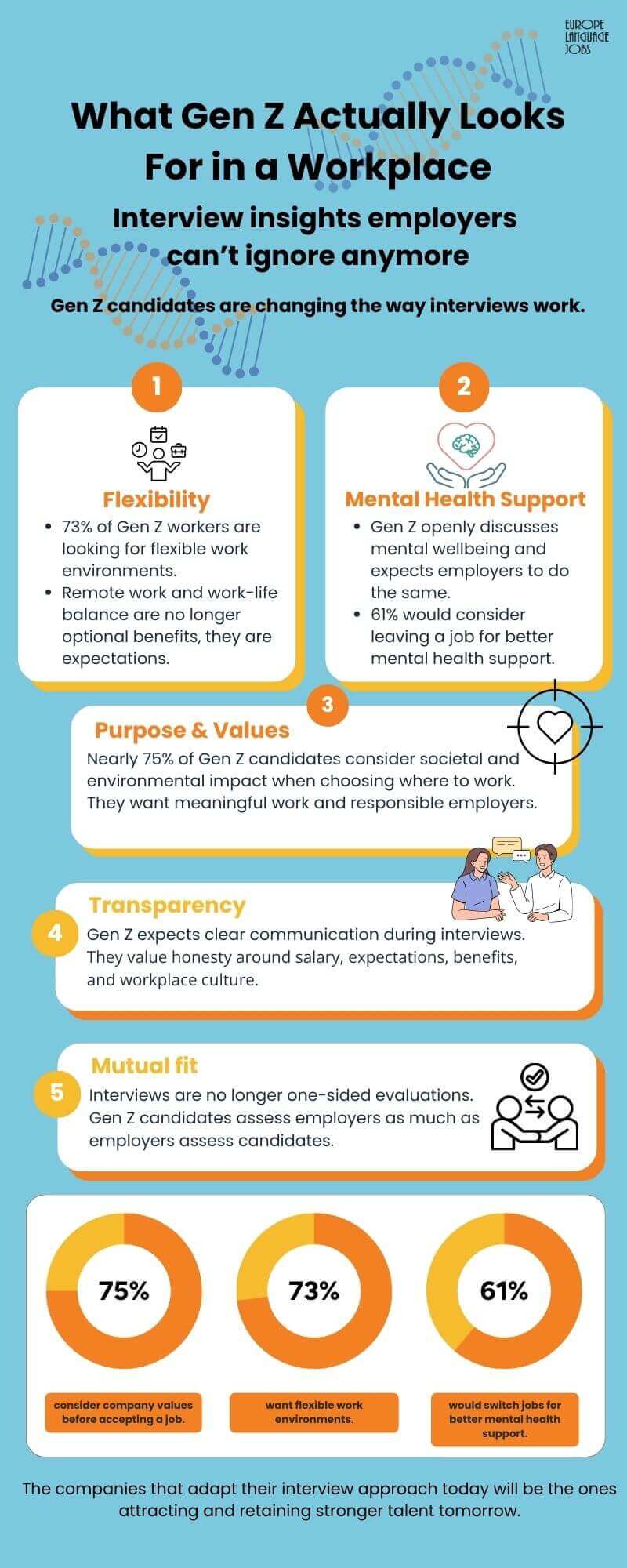
According to Deloitte’s 2024 Gen Z and Millennial Survey, nearly 75% of Gen Z candidates consider an organisation’s societal and environmental impact when choosing where to work. For employers, this means that motivation is no longer just about the position or salary. It’s also about whether your organisation clearly detains purpose, responsibility, and real impact.
In other words, before thinking about where they will be in 10 years, many Gen Z candidates want to understand what kind of future they are contributing to.
Tip: Reframe long-term questions to focus on growth.
Instead of expecting a fixed long-term plan, adapt your interview questions to explore how candidates think about development. Ask about the skills they want to build, the type of work they want to be involved in, or what kind of environment helps them perform at their best.
Ask instead:
-
What skills are you most interested in developing in the next few years?
-
What does progress look like to you in your career right now?
-
What kind of projects or work would you like to be involved in as you grow?
-
“Why do you want to work for our company?”
Traditionally, employers expect answers around career growth, company success, or long-term ambition. Candidates are often seen as more committed if they link their motivation to performance, progression, climbing the corporate ladder or contributing to the organisation.
Gen Z, however, might answer this question differently.
Instead of focusing only on professional achievement and how much they admire your company, they are more likely to mention factors such as work-life balance, meaningful tasks, a positive work environment, or even mental wellbeing. For some employers, this can come across as a lack of drive or ambition. In reality, it reflects a broader definition of motivation, one that goes beyond work itself and includes overall quality of life.
This shift doesn’t mean Gen Z is less motivated. It means they are motivated by different things and it helps you understand how to interpret their answers correctly.
Tip: Look beyond traditional motivation and focus on alignment.
When evaluating answers, don’t focus only on how well candidates “sell” their interest in your company. Pay attention to what they value: meaningful tasks, work environment, flexibility, purpose, and wellbeing.
Ask instead:
-
What stood out to you about this role or our company?
-
How would you like your work environment to look like?
-
What factors matter to you when you’re deciding between job offers?
-
“Why should we hire you?”
This question is traditionally about self-promotion. Candidates are expected to confidently highlight their strengths and explain why they stand out, why they are the best fit for the company. When this question is asked, candidates are expected to demonstrate why THEY are good enough to get the job.
This is where generational differences in the workplace become more visible. While previous generations often approached this question by emphasising achievements, loyalty, and long-term value, Gen Z tends to respond with a different perspective.
Rather than focusing solely on proving they are the best candidate, they are more likely to highlight how their skills align with the role and whether the position fits their expectations as well. This reflects a broader shift in workplace priorities, where mutual fit is more important than proving they deserve the job. It’s about fulfilling each other’s expectations, both as an employee and as an employer. Flexibility and purpose are, as well, as important as showing they do have the required skills and motivation. Their answers may feel less self-promotional, but often offer a more realistic view of long-term compatibility.
Tip: Evaluate mutual fit, not just self-promotion.
Rather than expecting candidates to prove they are the best at any cost, shift your focus to how well they understand the role and how realistically they assess their fit within it.
In the end, someone who puts the effort into understanding the role and makes sure their skills fit, is, indeed, highly valuable!
Ask instead:
-
How do you see your skills contributing to this role?
-
Which of your strengths do you think would be most useful in this position?
-
What kind of role or environment helps you perform at your best?
What Employers Often Misinterpret in Gen Z Interview Answers
Gen Z expects employers and recruiters to be direct. You should expect they will also be direct. A 2017 study found that 73% of candidates believe looking for a job is one of the most stressful experiences in life. In the same time, another study made by Deloitte found that aprox. 46% of Gen Z say work-life balance and mental well-being are their priorities when evaluating a potential job offer.
With these statistics in mind, it’s not surprising that Gen Z expects a communicative and open interview experience. They want clear answers and the opportunity to discuss these topics without discomfort or hesitation. For many of them, being transparent about expectations is simply normal. Given that, when a Gen Z candidate asks about workplace benefits, they are not being demanding, they are assessing how you treat your employees, how you define value, and whether people are seen as individuals first, not just as resources. As mentioned earlier, they are looking for organisations that genuinely respect and support their workforce.
Flexibility is another key factor, closely linked to both mental health and work-life balance. Gen Z candidates will often bring this up during interviews, and how you respond matters. According to SHRM research, 61% of Gen Z employees would strongly consider leaving their current job for one that offers better mental health support. Another interesting insight is that, according to World Economic Forum Research, 73% of Gen Z workers are looking for permanent flexible work environments.
Mental health challenges are real, and Gen Z is highly aware of them. Having grown up during the pandemic, they entered the workforce in a period of uncertainty that shaped how they view stability, stress, and work environments. This awareness makes them more intentional, not less resilient.
Candidates who openly discuss their expectations are often more likely to stay engaged long term, because they know what they are signing up for. Therefore, this is an opportunity for employers to make the right decision when selecting the candidates. Gen Z is trying to be self-aware and set boundaries; they are trying to make informed decisions, this is where all the unexpected questions come from.
Mental health in the workplace has always been important. Gen Z is simply bringing it more openly to the surface and demanding what many employees have been waiting for all along: fair work.
Job Interview Tips for Hiring Gen Z That Actually Work
We have to understand that Gen Z is not trying to challenge the system for the sake of it. They are responding to a work environment that has changed but still needs to change for the better of everyone. They bring expectations and healthy practices that were left unspoken before. The key for the employers is to change the way they evaluate and understand these interview answers with Gen Z.
Adapting your approach doesn’t mean to remove or adjust the entire structure you already have, nor to lower your standards. However, it’s important to update what you look for and how you interpret it.
Here are a few job interview tips that can help you align your hiring process with Gen Z expectations:
-
communicate in a tiprioritisemely manner;
-
be direct and transparent (and expect the same);
-
focus on potential, not just predictability;
-
make sure interviews feel like a two-way exchange and prioritize mutual fit;
-
redefine motivation;
-
show your workplace culture, don’t just say it;
-
talk about benefits and how you care about your employers;
-
encourage open conversations.
Effective job interviews are no longer about testing how well candidates adapt to your process. They are about ensuring your process reflects the reality of today’s workforce.
Gen Z is redefining interviews to make them more balanced, more honest, and more aligned with modern work. Employers who recognise this shift early will not only improve their hiring outcomes, but also build stronger, more engaged teams in the long run, and, of course, a more healthy workplace.
Last but not least, we prepared some examples of common interview questions (or maybe not so common, we let you decide) that employers can ask Gen Z in a job interview:
-
If you were working as a cashier at McDonald’s, what would be your biggest challenge?
-
How comfortable are you with a traditional office setup?
-
Can you share an example of a company or organisation whose values you admire?
-
What kind of work environment do you find challenging in a positive way?
-
What kind of flexibility helps you do your best work?
-
What would make you excited to accept this role? And what might make you hesitate?
Final thought: Gen Z candidates often give you clearer signals than previous generations. But it helps asking them questions that allow them to.