






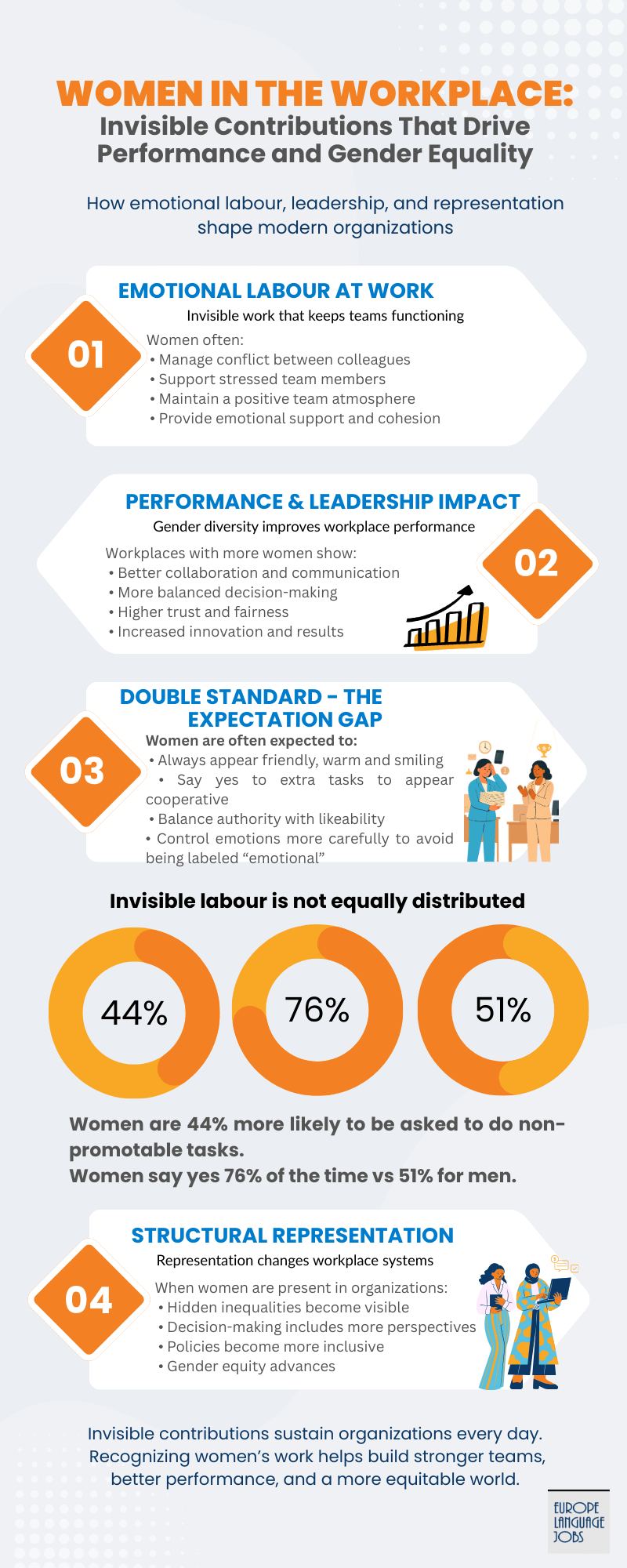
Did you know that women are made responsible for tasks in the office that are barely noticed?
Let’s see why everybody should care how workplaces truly look like when women are in it. And reality already gives us plenty of proof!
What is invisible labour in the workplace? Or, it actually has a name: office housework.
Women in the workplace contribute far more than the visible job performance. From emotional labour at work to leadership influence and structural representation, women play a crucial role in shaping organizational culture, collaboration and business performance. Yet, many of these contributions remain undervalued or invisible. Understanding how gender diversity in the workplace affects decision-making, productivity and workplace equality helps explain why women’s participation is not only a social priority but also a real business asset. And that means something important: women don’t just belong in the workplace, they are essential to it. Your presence matters and you deserve to be where you are!
If you’ve ever doubted whether you should apply for that role, speak up in that meeting, or aim for leadership, this is your reminder that your presence matters.
-
Emotional labour
Let’s see what emotional labour at work is exactly:
Emotional labour, in the workplace context, in simpler words, is is the ability to manage your own emotions and those of others to keep interactions productive and socially acceptable. In general, women in the workplace often become the default emotional regulators, by:
-
mediating conflict
-
comforting and helping new stressed co-workers
-
softening harsh communication
-
maintaining a “professional tone”
-
keeping the team atmosphere positive.
Emotional labour is many times overlooked because it’s seen as a personality trait, not a professional skill. But emotional intelligence is not a weakness, it’s part of being a good leader and team player. At the end of the day, it is a very valuable ability that women learned over the years and improves workplace culture. It makes a lot of difference in the way professional settings are approached. These skills connected with regulation of emotions are often overlooked but in real life they are necessary, but unfortunately many times they become invisible.
In many workplaces, this emotional regulation becomes an unspoken responsibility rather than a recognized task. When tensions rise, someone must de-escalate; when morale drops, someone must rebuild it. Women are often expected to step into this role automatically, not because it is assigned, but because it is assumed.
Over time, this shapes workplace culture itself. A functional, respectful environment does not appear by chance, it’s maintained through constant emotional effort. By managing stress, preventing conflict escalation, and supporting colleagues, women contribute to stability and cooperation, demonstrating how emotional labour quietly sustains everyday professional life. These are not only “some soft skills”, they are core professional skills that hold teams together.
In many workplaces, women often take on more emotional labour at work. According to a report by BBC Worklife, this invisible labour is usually expected from women, especially in male-dominated fields. To succeed, women are often expected not only to be confident and competent, but also kind, supportive and emotionally aware. Ironically, these invisible contributions help maintain workplace culture and teamwork, yet they rarely count toward promotions. This shows how invisible contributions women make in the workplace actually improve team functioning but still they remain undervalued in career advancement.
If you are someone who creates calm in chaos, who listens, who supports, who stabilizes a team, that is not accidental. That is a super power.
-
Hiring more women results in better performance
Let’s face it, bringing more women in the business and corporate world, getting more chances to diversity and equity in the workforce brings better results than before!
Organizational diversity is widely associated with stronger performance outcomes. When leadership includes a bigger range of perspectives, meaning ALSO women’s perspectives, decision-making tends to be more comprehensive and effective. Basically, co-workers achieve a common ground faster and they understand each other better at the workplace.
Talking from a business point of view and following the Grant Thornton report, Women in Business 2024, a diverse group of voices allows companies to better understand consumer needs, recognise subtle differences across markets and respond more strategically.
Translation: When women in leadership positions are present, workplace performance, collaboration and organizational success tend to improve.
Let’s take a closer look at how women’s leadership impacts workplace performance and culture:
-
women leaders often use a transformational leadership style. Women motivate, inspire, and bring people together around a shared goal
-
research shows women leaders are now seen as equally or more competent as men in leadership ability
-
teams with more women show better collaboration and problem-solving skills
-
gender diversity in the workplace leads to more balanced participation and teamwork
-
women leaders are often viewed as more honest, compassionate, and creative, qualities linked to strong leadership
-
the presence of women in leadership can increase trust and perceptions of fairness in an organization
-
having women in top roles can even help reduce gender stereotypes inside companies.
In simpler terms, when women are part of the workplace, especially in leadership positions, workplace performance and team collaboration usually improve. Gender diversity in the workplace helps communicate better, make smarter decisions and create a more positive workplace culture. Over time, this leads to more innovation, greater employee satisfaction and workplaces that reflect the needs of a diverse society.
So apply for the role. Raise your hand. Take the space. Leadership needs the skills you already have.
-
Gender double standards in the workplace - expectation gap
Many women take on invisible labour, meaning tasks that keep teams running but rarely get credit. These invisible tasks are part of a bigger pattern where women are expected to be caring and nurturing at work. The HuffPost article on office invisible labour shows that women are often the ones who handle team coordination and emotional support.
Tasks others depend on but rarely acknowledge.
As mentioned before and how Kelli Thomps underlines in her experience, women HAVE TO say yes when they actually want to say no, women would put in extra effort to be pleasant, helpful and under any circumstance to not upset anyone with their answers. Like in Kelli’s case, she firstly didn’t want to accept to coordinate this big project, knowing it would be a hard job to do and when she initially refused it, her “no” couldn’t be taken and all her work was never really rewarded, it was just taken for granted. The chances for this to happen in the case of a man are just much lower. Saying ‘no’ in these cases shouldn’t be considered more or less unprofessional.
Another common double standard women face at work is the expectation to always appear pleasant and approachable. Telling women to “smile more” might sound harmless, but it reinforces the idea that women should be cheerful and put others at ease, even when they are stressed, focused or uncomfortable. You are allowed to be focused. You are allowed to be serious. You are allowed to take up space without performing comfort for others. This expectation places an extra emotional burden on women that their male colleagues rarely experience and it subtly pressures women to prioritize others’ comfort over their own authenticity and professional presence.
Women are often expected to do emotional labour at work even when it isn’t part of their job. As described in an article on Medium, women in leadership roles are frequently expected to be nurturing, empathetic, and supportive in ways men are not. Many take on the role of “emotional managers” having to plan social activities or remember important dates like even birthdays, things that are strongly linked to social and emotional cohesion. In workplaces, especially in leadership positions, managing others’ emotions while controlling one’s own becomes an additional, usually unrecognized responsibility.
-
Structural effect of representation
Structural representation of women changes how workplaces function.
Moving (slowly, but slow progress is still progress) from “one size fits all” to more equitable approaches is a big step in the gender equity and equality movement, especially in the work field. For centuries men took over all the “cool” fields, leaving the “lower” spots to be filled by women (housework). Unfortunately, there are still a lot of stereotypes and wrong ideas about how women should be, behave and how they should look in our society. “Women belong in the kitchen” is not a phrase you would ever hear from us, as actually women’s power is what we believe in. We believe representation is one of the key factors in the feminist/gender equity and equality movement. We believe women occupying more and more spaces in the workfield is beneficial not only for them but for everybody. We can speak from our own experience as we are also an office consisting mostly of women!
Women leaders influence how decisions are made, not just who makes them. Including women’s perspectives brings a wider range of experiences into the conversation, helping highlight issues and insights that others in the workplace might not have considered. Women’s presence in leadership often leads to more gender-equitable policies because their experiences inform issues that male-centred leadership historically overlooks.
Every woman who enters a room changes it, even if she doesn’t realize it yet.
When women enter and participate in professional work spaces, they don’t just join existing systems, they reveal how those systems actually work. Research highlighted by Harvard Business Review shows that women are about 44% more likely than men to be asked to take on “non-promotable tasks,” such as organizing events, supporting colleagues, or serving on low-visibility committees. Women also agree to these requests far more often. When the requests for non-promotable tasks are made, according to HBR, men say yes 51% of the time and women say yes 76% of the time.
This pattern shows how women’s presence brings attention to hidden workplace expectations and structural inequalities that might otherwise go unnoticed.
Simply being present makes these patterns visible and opens the door for change toward greater workplace gender equity.
Conclusion
If you’ve ever questioned whether you belong in certain spaces, let this be your reminder: you do. Your competence is real. Your emotional intelligence is powerful. Your ambition is solid. Your perspective is valuable.
Creating equitable environments is not only fair; it’s a necessary step toward building a world that truly respects, supports, and values women. And that change doesn’t happen in theory, it happens when women apply, lead, speak up, and take their place.
You are claiming what has always been yours.