




Dutch and English share a fascinating linguistic connection. As two closely related Germanic languages, they have many similarities in vocabulary, grammar, and pronunciation. As an Eastern-European, I would have never thought about this!
They seem to look and sound different, but this guide will untangle this misconception! we’ll explore Dutch-English cognates, common shared words, and false friends that can confuse learners. Whether you’re learning Dutch or just curious about language similarities, this article will help you understand how these two languages overlap and where they differ!
General Similarities between English and Dutch
Before diving into specific words and cognates, let us first take a step back and explore the broader similarities between English and Dutch.
1. Both are Germanic languages
English and Dutch both belong to the West Germanic branch of the Indo-European language family. This means they share common linguistic roots and have developed from a similar syntactic and phonological system.
Although the two languages have evolved separately over time, they still retain many similarities in vocabulary, structure, and pronunciation. In fact, Dutch is considered to be closer to English, even more than German.
2. Both use the Latin alphabet
English and Dutch both use the modern Latin alphabet, which makes reading and writing much more accessible for learners of either language.
Unlike some other Germanic languages, Dutch does not use additional characters like umlauts on the vowels (Ää, Öö, Üü), but it does feature unique letter combinations such as “ij”, which may be unfamiliar to English speakers at first.
3. Similar sentence structure
One of the most helpful similarities between English and Dutch is their relatively similar sentence structure, especially in simple sentences.
For example:
-
Ik drink water = “I drink water”
-
Hij werkt vandaag = “He works today”
4. Both use Arabic numerals
Just like English, Dutch uses the digits 0–9 to form all numbers.
There are also similarities in how numbers are constructed. For example, teen numbers follow a comparable pattern:
-
English: thirteen, fourteen, fifteen
-
Dutch: dertien, veertien, vijftien
However, like German, Dutch sometimes reverses the order for numbers above twenty:
-
eenentwintig = “one and twenty” (21)
5. Shared loanwords from other languages
Both English and Dutch have borrowed extensively from other languages, particularly Latin, French, and Ancient Greek.
Here are some words derived from these languages that look very similar both in Dutch and English (or are even the same):
-
Restaurant (French)
-
Politiek / politics (French)
-
Universiteit / university (Latin)
-
Cultuur – culture (Latin)
-
Telefoon / telephone (Ancient Greek)
-
Theater / theatre (Ancient Greek)
Common English Words Used in Dutch
These common English words used in Dutch are mostly banal, everyday vocabulary, and names of objects.
-
Arm
-
Bank
-
Bed
-
Film
-
Gas
-
Hand
-
Hotel
-
Kind
-
Land
-
Man
-
Park
-
Ring
-
Sport
-
Taxi
-
Team
-
Wind
Common Dutch Words Used in English
-
Cookie (from koekje)
-
Boss (from baas)
-
Yacht (from jacht)
-
Landscape (from landschap)
-
Dock (from dok)
-
Freight (from vracht)
-
Sketch (from schets)
-
Gin (from jenever)
-
Santa Claus (from Sinterklaas)
-
Dollar (from daalder)
-
Reef (from rif)
-
Spool (from spoel)
-
Trek (from trekken)
-
Waffle (from wafel)
Very Similar Dutch and English Words (Different Spelling)
-
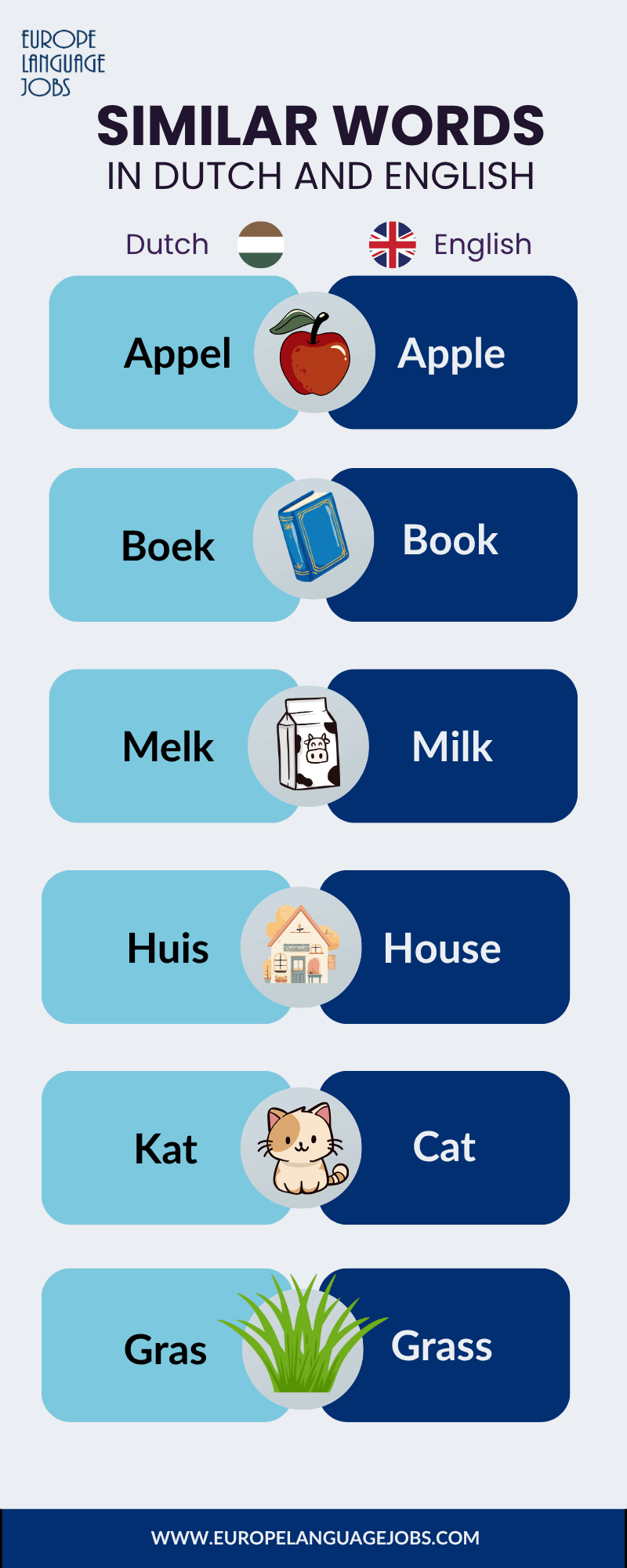
Appel – apple
-
Bed – bed
-
Boek – book
-
Broer – brother
-
Vader – father
-
Moeder – mother
-
Huis – house
-
Kat – cat
-
Melk – milk
-
Zout – salt
-
Gras – grass
-
Boom – tree
-
Blauw – blue
-
Groen – green
-
Rood – red
-
Zwart – black
-
Wit – white
-
Licht – light
-
Nacht – night
-
Dag – day
-
Zomer – summer
-
Winter – winter
-
Nieuw – new
-
Oud – old
-
Goed – good
-
Groot – big
-
Lang – long
-
Werken – to work
-
Komen – to come
Many of these similarities come from shared Germanic roots, which is why basic vocabulary (family, nature, colors, verbs) tends to look so familiar.
English Words Used in Dutch with a Different Meaning
-
Eventueel = potentially
-
Actueel = current
-
Dik = fat
-
Smoking = tuxedo
-
Slip = underwear
-
Controleren = to verify
-
Fabricage = manufacturing
-
Sollliciteren = to apply for a job
-
College = lecture
-
Stage = internship
-
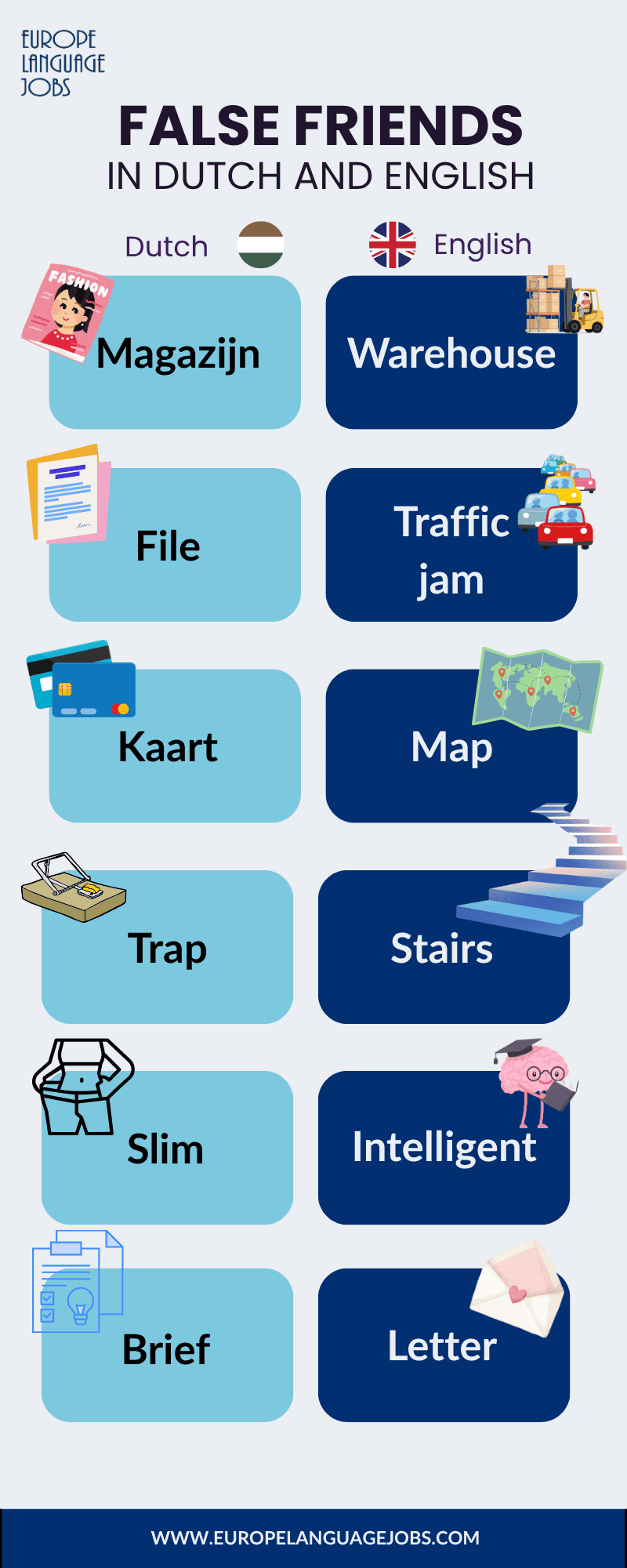
Magazijn = warehouse
-
Half vijf = 4:30
-
Smal = norrow
-
Dier = animal
-
Sterven = to die
-
Meaning = opinion
-
Brave = obedient
-
Dapper = brave
-
Hond = dog
-
File = traffic jam
-
Kaart = map
-
Glad = smooth
-
Trap = stairs
-
Slim = intelligent
-
Brief = letter
Conclusion
There’s no doubt about it: Dutch and English share a remarkable amount of vocabulary.
And, just like in Dutch, the overlap between German and English shows how languages from the same family can share vocabulary, structure, and even surprising meanings.