Labour Day has always been about one thing: fair work.
Fair pay, fair conditions, and respect for employees.
Unfortunately, in 2026, “fair” still doesn’t look the same everywhere. Depending where you move on the map, you will find different approaches that companies take in order to function optimally. Work culture varies from North to South, from West to East and we know for sure there is always space for improvement, from the recruitment process to the salary expectations. Understanding these differences as a company is important when it comes to hiring international employees.
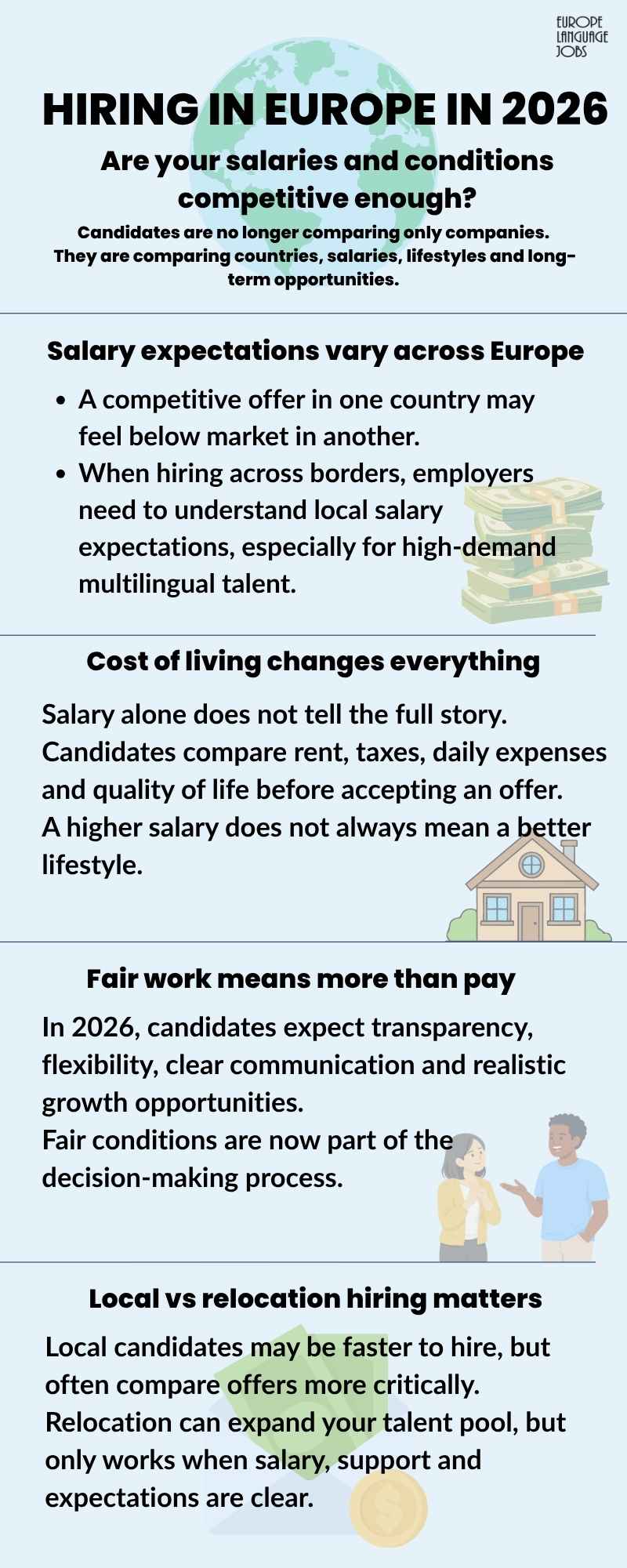
Today, candidates are not just comparing companies. They are comparing countries, salaries, services and lifestyles. And if your offer doesn’t match local expectations, they simply won’t say yes.
Why Hiring in Europe Is More Competitive Than Ever?
Much of the conversation today focuses on how difficult it is for candidates to find and secure a job. But employers are facing their own challenges. Hiring has never been truly simple. While some periods may have felt more manageable than others, the reality is consistent: candidates struggle to find the right opportunity, and employers struggle to find the right fit.
Times have changed a lot, especially in the past 6 years, after COVID. Now it’s very normal and even expected to work remotely, something we wouldn’t have necessarily imagined before 2020. European labour market trends rely more and more on cross-boarder hiring. One reason why? Because now, if you have a laptop and good connection, you can opt either for a local candidate from Spain (if you are based in Spain, for example), or choose the one from Netherlands if they fit better to what you’re looking for!
Right now, many companies are actively searching for multilingual talent and this is not by coincidence. Europe is gradually becoming not just a single market for trade, but a shared employment space. Companies are no longer limited to hiring within their own country, and candidates are increasingly open to working across borders.
Another factor making cross-border hiring more accessible is the gradual simplification of regulations across Europe. Recent developments, such as the EU framework on cross-border telework, allow employees to work from their home country while remaining under the employer’s social security system, reducing administrative complexity for companies. At the same time, initiatives like the BEFIT proposal aim to align corporate tax rules across EU countries, making it easier for businesses to operate internationally. While not fully unified yet, these changes are steadily lowering the barriers to hiring in Europe across borders.
This shift is driven by two key factors. On one side, mobility has increased significantly, with more professionals willing to relocate or work remotely for international companies. On the other hand, skills shortages across Europe continue to grow, pushing employers to expand their talent search beyond local markets. As a result, hiring in Europe has become less about geography and more about finding the right skills, regardless of location.
For employers, this creates a major opportunity, especially when it comes to multilingual hiring. What was once seen as a barrier is now a competitive advantage. Language skills are no longer just a “nice to have”, but a key business asset. At the same time, this also raises the level of competition. Candidates with language skills have more options and can choose between multiple markets, not just multiple companies. This means that attracting multilingual talent is not only about finding candidates, but also about offering conditions that can compete across borders.
Salary Expectations in Europe: What Employers Need to Know About Job Offers
Whether we like it or not, the truth is that salary will always be the main decision driver in accepting or refusing a job offer.
Salary expectations in Europe have changed as the economy changes. What was worth 1000 euros 20 years ago, for sure doesn’t have the same value today anymore. The way we move across countries will show many differences within wages and the power of purchase & quality of living one can have with that salary. Salary expectations are increasingly shaped by the cost of living, with candidates focusing less on the number itself and more on what it allows them to afford. While Europe may feel like a single job market, salary levels are still heavily influenced by local economies, cost of living, and overall demand for talent.
Northern and Western European countries consistently offer the highest average salaries. Markets such as Switzerland, Luxembourg, Denmark, and Germany tend to lead in terms of gross earnings, reflecting stronger economies and higher living costs. In contrast, Southern and Eastern European countries generally report lower average salaries, even though this doesn’t necessarily mean a lower quality of life, whereas there are a lot of factors to be taken into consideration when measuring it. The gap between regions can be substantial, which is why candidates should be aware of how their compensation compares internationally and recruiters should always explain these differences when hiring abroad, even the remote recruiters.
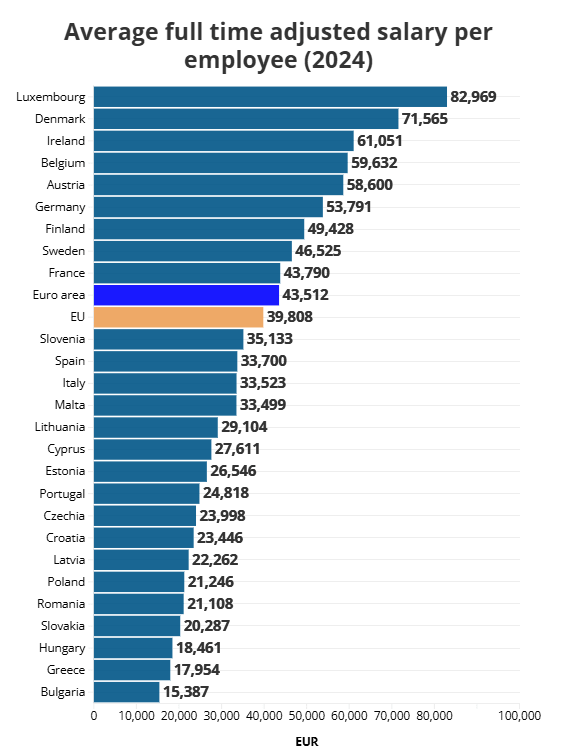
This growing transparency is also reinforced by recent EU initiatives, such as the pay transparency directive, which aims to give candidates clearer insights into salary ranges and reduce pay inequality. As a result, candidates will be more informed than ever before. They will compare their salaries expectations in Europe across all the countries not only from their local markets.
For employers, this creates both a challenge and an opportunity. When hiring in Europe, it is no longer enough to offer a competitive salary within one country if your talent pool is international. Candidates know their market value. They may compare your offer with opportunities in higher-paying markets, even if they are not actively planning to relocate. But we can agree that these relocation packages for supporting moving and working abroad are a real game changer.
Cost of Living vs Salary Information: What Candidates Actually Compare
When evaluating job offers, as mentioned previously, salary alone is no longer enough. Candidates look beyond the number itself and focus on what that salary actually allows them to afford. This is why it is essential to understand the relationship between cost of living vs salary in order to get how candidates make decisions, especially in terms of relocating abroad.
In most European cities, housing costs represent the largest expense, often taking up a significant share of monthly income. Recent comparisons (2025 research report from Gisma University of Applied Sciences) of rent-to-salary ratios show that even in cities with relatively high wages, the cost of rent can quickly reduce real purchasing power. As a result, a salary that looks attractive on paper may not translate into a comfortable lifestyle in practice. Candidates are aware of this and tend to evaluate offers based on how far their income will go after essential expenses are covered.
This is linked to the concept of “living wage”. Unlike minimum wage, which is set by governments and can vary widely across countries, a living wage reflects the actual cost required to maintain a decent standard of living in a specific location. In some parts of Europe, minimum wages do not fully cover basic living costs, which creates a gap between what is legally acceptable and what candidates consider fair. This directly influences salary expectations in Europe, as candidates expect offers that align with real-life expenses, not just legal benchmarks. Why? Because a slightly lower salary in one country may offer a better quality of life than a higher salary elsewhere, depending on the cost of living in Europe and overall affordability.
These shifts are also shaping broader employee expectations in Europe, particularly among international and multilingual talent. Candidates are more informed, more mobile, and more strategic in their decisions. They are not simply asking “How much will I earn?” but rather “What kind of life can I build with this salary?”
To attract talent in Europe, employers must align their offers with both salary expectations and the local cost of living. It requires a deeper understanding of local economic realities and candidate priorities. When hiring in Europe, companies that take into account cost of living differences and communicate this clearly in their offers are far more likely to attract and retain the right talent. Ultimately, candidates don’t just evaluate a job, they evaluate their future, potential quality of life.
What Candidates Expect from Employers and Companies in 2026
Labour Day has traditionally been about fair pay and fair working conditions. But in today’s job market, “fair work” goes beyond that. Candidates are more informed, more selective, and more aware of their value. As a result, expectations have shifted significantly, and employers need to adapt if they want to remain competitive.
Today, candidates don't evaluate only the role, they evaluate the overall experience and long-term value an employer can offer. Some of the key expectations shaping hiring decisions in 2026 include:
-
Competitive and transparent salaries: Salary remains the most important factor, but candidates now expect clarity from the start. Job seekers are increasingly drawn to companies that openly communicate salary ranges and avoid unclear or vague offers.
-
Flexibility and work-life balance: Remote and hybrid work are slowly becoming to not be considered benefits, they are expectations. Candidates want flexibility in how and where they work, as well as a better balance between professional and personal life.
-
Clear communication and efficient hiring processes: Long or unclear recruitment processes are a major reason candidates drop out. Speed, transparency, and regular communication are key to maintaining candidate interest.
-
Career growth and long-term development: Candidates are increasingly looking beyond the immediate role. Opportunities for learning, development, and career progression play a major role in decision-making.
-
Strong company culture and purpose: Culture, values, and overall work environment matter more than ever. Candidates want to work for companies that align with their personal values and offer a positive, supportive workplace.
-
Stability and security: In a constantly changing economic landscape, candidates value stability. Clear contracts, reliable income, and long-term prospects can make a significant difference.
What “fair work” means today is closely tied to these evolving expectations. It is no longer just about meeting minimum standards, but about creating an environment where candidates feel valued, supported, and confident in their future.
How to Stay Competitive When Hiring in Europe
One of the key insights we want you to keep is how important transparency is. Clear communication around salary, responsibilities, and growth opportunities helps build trust early in the process and reduces drop-off rates.
Staying competitive when hiring in Europe today is less about reaching more candidates and more about aligning with their expectations. As talent becomes more mobile and informed, employers are no longer competing only within their local market, but across countries and industries.
About Andra Dîrvariu
Content Creator
Andra is a communication specialist and content creator passionate about human rights, marketing, and international experiences. A travel lover with a deep curiosity for cultures and people, she brings a global, equitable and socially aware perspective to her writing.
She believes in the power of storytelling to connect, empower, and spark change, aiming to inspire readers to explore the world with empathy and curiosity.
Andra is a communication specialist and content creator passionate about human rights, marketing, and international experiences. A travel lover with a deep curiosity for cultures and people, she brings a global, equitable and socially aware perspective to her writing.
She believes in the power of storytelling to connect, empower, and spark change, aiming to inspire readers to explore the world with empathy and curiosity.