




Women have always worked, they just didn’t have the legal right to actually do it before. Women weren’t absent from the workforce, they were absent from power.
Only a few decades ago, the workplace looked very different for women. The majority of professions weren’t open for them, leadership positions didn’t exist and financial independence was almost impossible to achieve.
Now, look at us! Today, women are shaping industries, leading companies, and transforming the way we think about work!
The journey from not being able to join the workforce to creating successful business has not been simple, but it shows how powerful social change can be.
Redefining “Women in the workplace”
For a long time, the world of work was divided by these unwritten rules - rules that just seemed to make sense of societal norms established centuries ago?? maybe would be better. With the time passing, societies evolving and the fight for women’s rights gaining momentum, women started to take space in many fields in the workforce.
However, certain careers had been seen as “women’s jobs,” while others were considered “men’s jobs” still. Teaching, nursing, and caregiving were often viewed as natural paths for women, while fields like engineering, finance, or technology were largely dominated by men.
Today, those “rules” are slowly but clearly changing. Women are entering industries that once excluded them - from law and medicine to technology and business leadership. Higher education has played a big role in this shift. In many European countries, women now graduate from universities at higher rates than men, creating a larger pool of qualified women ready to enter professional and technical fields.
This shift is about more than statistics. It represents a cultural transformation in how talent and potential are understood. Careers are slowly becoming defined less by gender and more by skills, ambition, and opportunity.
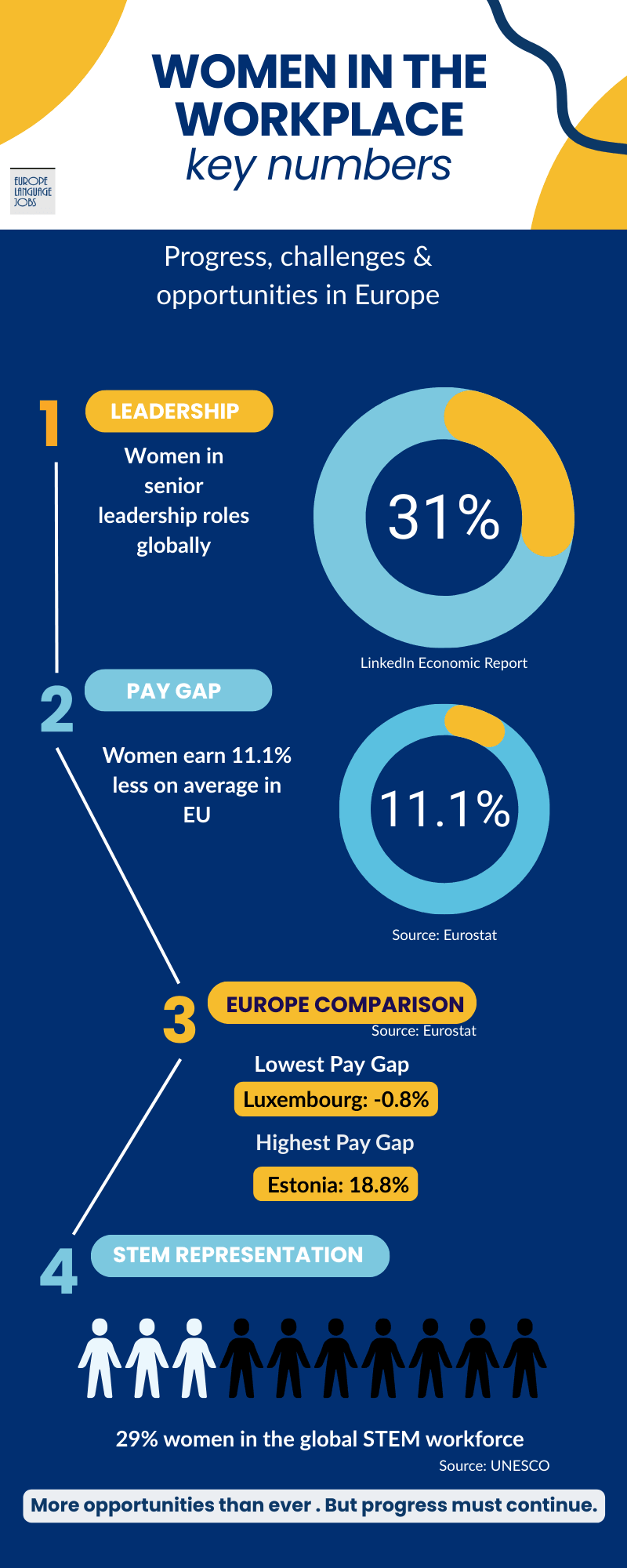
Even so, some industries still have a long way to go. In science, technology, engineering, and mathematics (STEM) women remain underrepresented. According to UNESCO, women make up about 29% of the global STEM workforce. This shows that while progress is real, these fields still need to improve the gender balance. And even if the progress it’s a bit slower than maybe we would like it to be, for women candidates entering the job market today, this shift still means more opportunities than ever before. Fields that were once impossible for women to access are increasingly open, creating new career paths and opportunities for women.
But the direction of change is clear. More women are becoming engineers, scientists, entrepreneurs, and executives than ever before. Each generation sees new role models, new possibilities and this is amazing! Today the young generation of women have more opportunities than our mothers and grandmothers ever had.
The idea that certain careers belong to one gender is gradually fading and with that, we go further to the…
Importance of financial Independence for women in the workplace
As more women entered the workforce, another major shift began to take shape: financial independence. For much of history, women’s economic security depended largely on fathers or husbands. Now, a job is no longer just a way to contribute a little extra income. It became a path to autonomy, stability, and long-term security.
Women’s participation in the workforce is no longer seen as temporary. In the past, many women were expected to leave their jobs once they married or had children. Today, long-term careers are actually a thing, many women choose to focus on their careers, achieve high positions in their fields, and become known for what they achieve!
One thing that helped to accelerate this change is access to education. More and more women are currently earning university degrees and entering professions that offer opportunities for advancement and stable, long-term careers. From being denied independence to becoming very good teachers, psychologists, police officers, engineers, accountants and CEOs!
Building a career today means more than finding a job, it means gaining the freedom to build your own professional and personal path.
Moving to women leadership in the workspace
As women’s presence in the workforce has grown, so has their presence in leadership.
Not only did their presence grow - they increased the business performance too! For many women starting their careers today, leadership roles that once seemed out of reach, are becoming more visible and attainable.
More companies and institutions are recognizing the value of diverse leadership teams. Different perspectives can improve decision-making, encourage innovation, and better reflect the diverse societies that organizations serve. More women are being promoted into management positions and executive roles than in previous generations.
Comparing today’s workforce to that of 30 years ago, the difference is clear. Women have more opportunities and a stronger presence than ever before.
However, recent data shows that this progress is not moving forward as quickly as many expected.
According to a new report shared by LinkedIn ahead of International Women’s Day, women’s ambitions to become leaders remain strong, but companies are not keeping up with that ambition.
Since 2023, progress for women entering top management roles has slowed across 16 countries. This includes some of the largest economies in Europe, like Ireland, Germany, France and the UK. Spain, however, showed a small but positive increase, reaching 32% women in top management positions (+0.3% )
The impact is visible at the highest levels of organizations. Women currently represent about 31% of senior leadership roles globally, a number that has barely changed in recent years. Between 2015 and 2022, the share of women leaders was increasing steadily, but since then the growth has slowed significantly.
In other words, women clearly want to lead, and many are ready to lead. But the structures inside organizations are not always moving at the same pace.
On the other hand,
Many women are responding to this barrier by creating their own opportunities. The number of women starting their own businesses has been gradually increasing across Europe. In countries like Italy and the United Kingdom, the share of women founders has grown in recent years, showing that when traditional career paths slow down, many women choose to build their own.
One Challenge women face in the workplace
Even though women have gained more access to education, careers, and leadership positions, pay equality is still an important issue in the modern workplace. Across Europe, women on average still earn less than men.
According to data from Eurostat, women in the European Union earned on average 11.1% less per hour than men in 2024 across the economy as a whole. In the euro area specifically, the gap was slightly higher at 11.4%.
However, the situation is not the same in every country. Across EU member states, the gender pay gap varies widely. In 2024, the difference ranged from –0.8% in Luxembourg to 18.8% in Estonia, showing a gap of almost 20 percentage points between countries.
A small country with a surprising result
While much of the conversation around the gender pay gap focuses on where things are going wrong, it’s also worth highlighting the countries that are making progress. Luxembourg is one notable example. There, the gender pay gap has occasionally been negative (-0.8%), meaning that on average women earn slightly more than men.
While many discussions about gender equality focus on pay gaps, there are also some interesting exceptions. One notable example is Luxembourg. In this country, the adjusted gender pay gap has occasionally been negative, -0.8%, meaning that on average women earn marginally more than men.
This does not mean that gender equality is completely solved. Luxembourg has a small labor market with specific economic structures. However, it shows that different outcomes are possible when policies, labor market conditions, and opportunities align.
How do laws and policies protect women in the workplace?
As more women entered the workforce, it became clear that access to jobs was only a part of the story. Workplaces also needed rules and protections to ensure fairness, safety, and equal opportunities.
Over the years, governments and institutions across Europe have introduced policies designed to support women in the workplace and create a more balanced professional environment. Many of these gender equality policies are supported by regulations from the European Union, which promote gender equality across member states. It’s always good and even necessary to know your rights!
Some key protections include:
These protections are needed to ensure that progress for women is supported by clear rights and policies. And we still have more to go!
Conclusion
Women’s presence and participation in the workforce transformed how talent and leadership are seen. This wouldn’t have happened if they didn’t have the courage first to enter a world that wasn't mainly made for them.
As women continue to claim their place and opportunities keep expanding, the next chapter will be written by those women who are reshaping workplaces every day, proving that gender equality & equity doesn’t just benefit women, it builds stronger workplaces and a better future for everyone.