





Recruiting Dutch speakers can be challenging for HR teams across Europe, especially when trying to attract Dutch-speaking candidates to international roles.
How to Recruit Dutch Speakers in Europe
Recruiting Dutch speakers has become increasingly competitive across Europe, especially for companies expanding into the Benelux market or building multilingual teams.
However, many recruiters overlook a key factor that often determines success: understanding how Dutch-speaking candidates think, communicate, and evaluate opportunities.
In reality, candidates are not usually lost because of weak offers, but because of small misalignments in communication, expectations, or positioning.
After having the opportunity to meet and speak with Emma Peters, HR Coordinator at Europe Dunlop Sports in Eindhoven, Netherlands, we included some practical do’s and don’ts of recruiting Dutch speakers.
Companies hiring Dutch speakers often face strong local competition, which makes standing out even more important.
What makes Dutch-speaking candidates different in the hiring process?
Dutch-speaking professionals are often described as direct, pragmatic, and independent. These traits strongly influence how they approach the hiring process.
One of the key differences is their communication style. Dutch candidates are very direct and expect clear, honest communication in return. They are comfortable asking questions and challenging information if something is unclear.
Another important factor is their high level of English proficiency. Since most Dutch candidates speak fluent English, language alone is rarely enough to attract them. The opportunity itself must be strong.
From a market perspective, attracting Dutch talent is pretty challenging. According to Eurostat, the Netherlands consistently has one of the lowest unemployment rates in Europe. Unemployment in the Netherlands is around 3–4% (Eurostat data), significantly below the EU average (~6%), meaning Dutch candidates already have many local opportunities.
Because of this, recruiters must work harder to present opportunities that clearly stand out.
Why work-life balance is key when recruiting Dutch speakers
Did you know it’s very common in the Netherlands to have a fully paid day off if you have an important personal event you have to attend, such as a wedding?
Dutch work culture shows the importance of treating your employees not just like a simple worker who is productive in your company, but to demonstrate you care about your employees.
Another important aspect of work-life balance in the Netherlands is the holiday allowance (vakantiegeld). It is very common for employers to provide an additional payment, usually around 8% of the annual salary, before the summer period. This bonus is specifically intended to help employees finance their holidays and enjoy time off.
For Dutch candidates, this is not seen as an extra perk, but rather as a standard expectation. When considering opportunities abroad, they often compare whether similar benefits or compensation structures are offered.
Because of this, when recruiting Dutch-speaking professionals, it is important to clearly communicate how your offer supports their lifestyle, not just their career.
To make your job offer more attractive, consider highlighting:
-
flexible working hours and remote/hybrid options,
-
paid time off policies and additional leave benefits,
-
support for personal events and work-life balance,
-
bonuses or financial benefits (e.g. holiday allowance or similar perks),
-
a company culture that values well-being and balance.
They might seem like “small details”, but these extra-benefits significantly increase your chances of attracting Dutch talent in a market where Dutch candidates already have strong local opportunities. If you want to go deeper into this topic, you can also explore how to attract Dutch speaker.
How to communicate with Dutch-speaking candidates
Be direct, clear, and transparent!
When recruiting Dutch speakers, one of the most important factors is communication style.
Dutch candidates are known for being honest, direct, and efficient. They expect the same from recruiters.
As highlighted in our webinar, Dutch professionals avoid unnecessary formalities and prefer clear, transparent communication from the start.
To improve your hiring results:
-
clearly explain the role and responsibilities,
-
be honest about expectations and challenges,
-
avoid vague or overly promotional language,
Direct communication is not seen as rude at all, it is seen as professional and respectful.
It’s equally important for HR teams to show understanding, kindness, to take notes and listen actively to the candidate from the start of the recruitment process.
Salary expectations: transparency matters more than persuasion
Dutch professionals are used to a very structured compensation system, along with clear guidance on taxes and insurance contributions, and as a result they expect:
-
a clear salary range that can be found inside the job ad,
-
transparency and explanation about the difference between net vs gross salary,
-
information about bonuses (like holiday allowance) that are easy to find,
-
a realistic overview of the cost of living in the destination country if the job requires relocation.
Salary expectations when hiring Dutch speakers
When it comes to Dutch candidates, salary is not just important, it is often the main decision factor. This is largely due to the high cost of living and taxation in the Netherlands, which makes candidates very aware of their net income and overall financial stability.
Because of this, Dutch professionals tend to carefully analyze offers and compare them with what they already have locally. If the salary is not competitive or clearly explained, it can quickly become a dealbreaker.
However, this is where companies abroad have an opportunity to stand out. While they may not always match Dutch salaries, they can offer additional value that goes beyond the numbers.
For example, during the webinar, Emma mentioned how workplace relationships and culture play an important role - simple things like spending time with colleagues or even doing activities such as playing tennis with a manager after work can create a more relaxed and human environment. Instead of offering ‘sunny weather’, your company can offer after work activities that will allow employees to enjoy the sunny weather that is not available for them in the Netherlands.
These elements might seem small, but they reflect something important: a workplace where employees feel comfortable, included, and connected.
Dutch candidates evaluate the full offer, including:
-
work environment & flexibility,
-
financial & career benefits,
-
learning & development,
-
recognition & celebrations,
-
health & well-being.
To successfully hire Dutch talent, transparency around salary is not optional - it is expected.
Work environment and flexibility for Dutch-speaking candidates
Team building and creating a supportive and friendly work environment are taken very seriously in the Netherlands. It is common to celebrate Easter or Christmas by bringing small chocolates or gifts and sharing them with coworkers. What is more, seemingly less important holidays like Pancake Day (Pannenkoekendag) are taken equally seriously. Why? They allow the people inside teams to get to know each other better, decrease stress-levels, and show employees they are more than just a number.
Another way of taking care of employees is providing flexibility. It is very common in the Netherlands to:
-
start and finish work at flexible times,
-
work remotely or in a hybrid setup,
-
adjust working hours when needed.
This way employers do not only build a friendly relationship with their employees, but also build trust and a sense of loyalty, which in the long run increases the work satisfaction levels and decreases high turnover rates.
Recognition and company culture in Dutch workplaces
Creating a workplace where employees feel valued as individuals, not just as workers, is extremely important in the Netherlands. One of the most common examples of this can be seen in everyday office traditions. When an employee celebrates their birthday, it is expected that they bring cake to share with the team, turning a simple moment into a shared experience. Colleagues often bring small gifts, and in some cases, the company may also show appreciation through gestures such as a gift card, allowing the employee to treat themselves.
These moments may seem small, but they play a key role in building stronger relationships within teams, creating a positive atmosphere, and making employees feel genuinely appreciated.
When these elements are missing, candidates are more likely to lose interest - even if the salary is competitive. For recruiters, this means that understanding Dutch work culture is not optional. Adapting to these expectations can make a significant difference in how attractive your offer is and how well it resonates with Dutch-speaking candidates.
Financial and career benefits Dutch candidates expect
Dutch people are very serious about their careers, their education system prepares them for career development from an early age. That is why career growth opportunities, a clear progression path and stability are some of the most crucial elements.
They want to understand not only what they get today, but also how they can grow in the company over time.
Learning and development opportunities for Dutch employees
It's important to remember that the learning opportunities your organisation offers to the candidates do not always have to be connected to the job. Many companies offer things like courses, mentorship, or even a learning budget that employees can use to develop their own interests. It can be anything from improving soft skills to learning something completely new and unrelated to their work. Why?
As mentioned before, such a gesture proves that your company cares about its employees. The chances for a candidate to be interested in a job opportunity rise when the company allows them to invest in their interests. They may find a job with a slightly higher salary, but will they find an equally supportive workplace that allows them to grow both professionally and personally?
One example is a language course. Language courses are extremely important for those candidates who, to get the job, need to relocate to another country. Even if the job does not require the knowledge of the local language, offering a course to learn it reduces the stress connected with moving abroad and makes the candidate more likely to accept the job offer.
Health and well-being benefits in the Netherlands
In the Netherlands, having health insurance is mandatory, and employees pay for it every month themselves. Some companies offer discounts or contributions towards health insurance as part of their benefits package. Even small support in this area can be very appealing for Dutch candidates, as it directly impacts their monthly expenses and shows that the company understands their everyday needs.
Why speed matters when hiring Dutch-speaking candidates
Dutch professionals value efficiency, structure, and respect for their time. If the process takes too long or lacks communication, they are likely to lose interest or accept another offer.
Common mistakes include long gaps between interview stages; no clear timeline shared with the candidate and delayed or missing feedback.
Final tips for recruiting Dutch speakers successfully
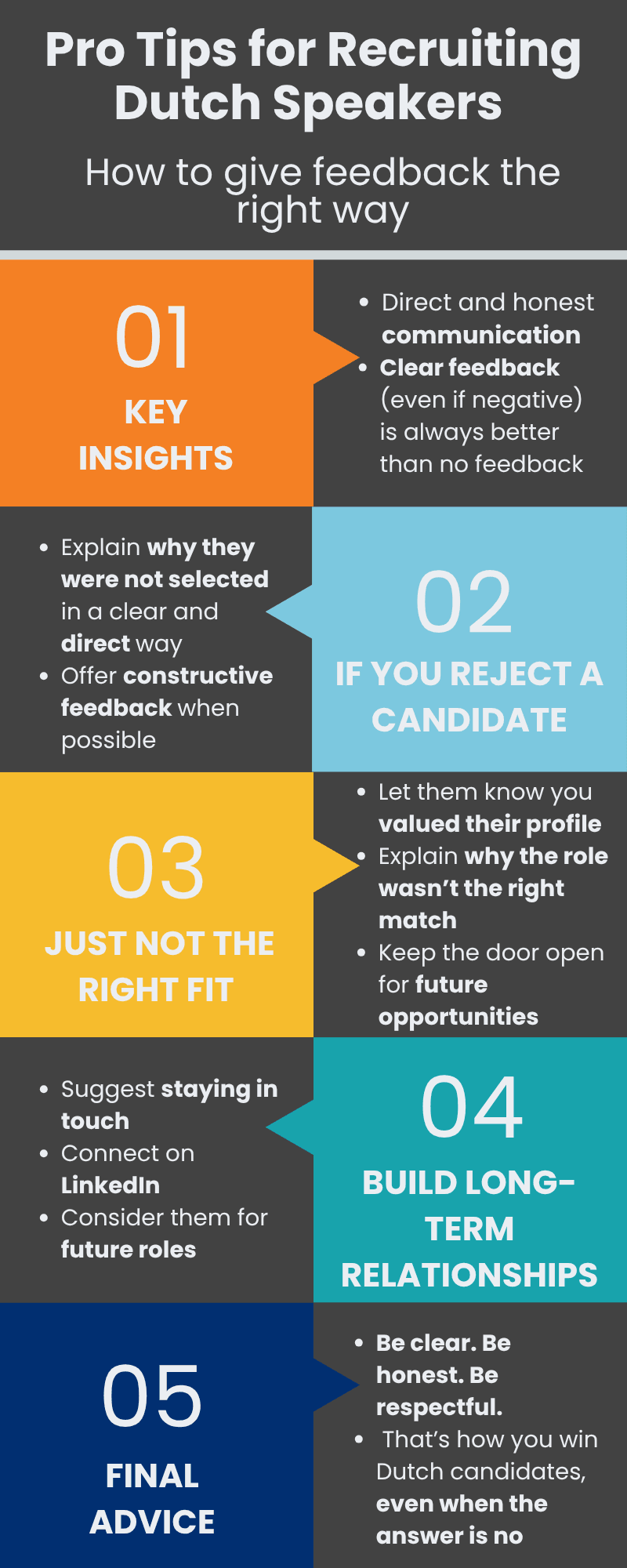
Dutch candidates appreciate directness, even when the message is negative. In fact, clear and honest feedback is often better than no feedback at all.
If you decide not to move forward, it’s recommended to:
-
explain briefly why the candidate was not selected,
-
give constructive feedback where possible.
And if the candidate was strong but not the right fit at that moment:
-
make it clear you valued their profile,
-
suggest staying in touch for future opportunities.
Recruiting Dutch speakers: keep it clear and show off your offer
If there’s one thing to remember when recruiting Dutch speakers, it’s this: don’t make candidates guess.
Be clear about the role, be transparent about the salary, and explain exactly what they’re getting. A strong, well-structured job description already puts you ahead of many companies.
At the same time, don’t hold back: show off your benefits. Talk about flexibility, work-life balance, bonuses, learning opportunities, and anything that makes your offer better than others.
Dutch candidates have a lot of options, so if your offer isn’t clear or doesn’t stand out, they’ll just move on.
Keep it simple, be honest, and make it easy for them to say yes.