






Recruiting German-speaking talent has become increasingly competitive across Europe, particularly for companies expanding into DACH markets or building multilingual teams. While many organizations focus on improving their hiring strategies, fewer pay attention to a critical factor that often determines success or failure: understanding how German-speaking candidates think, communicate, and evaluate opportunities.
In reality, many recruiters do not lose candidates because of weak offers but mostly because of small misalignments in communication, expectations, or approach.
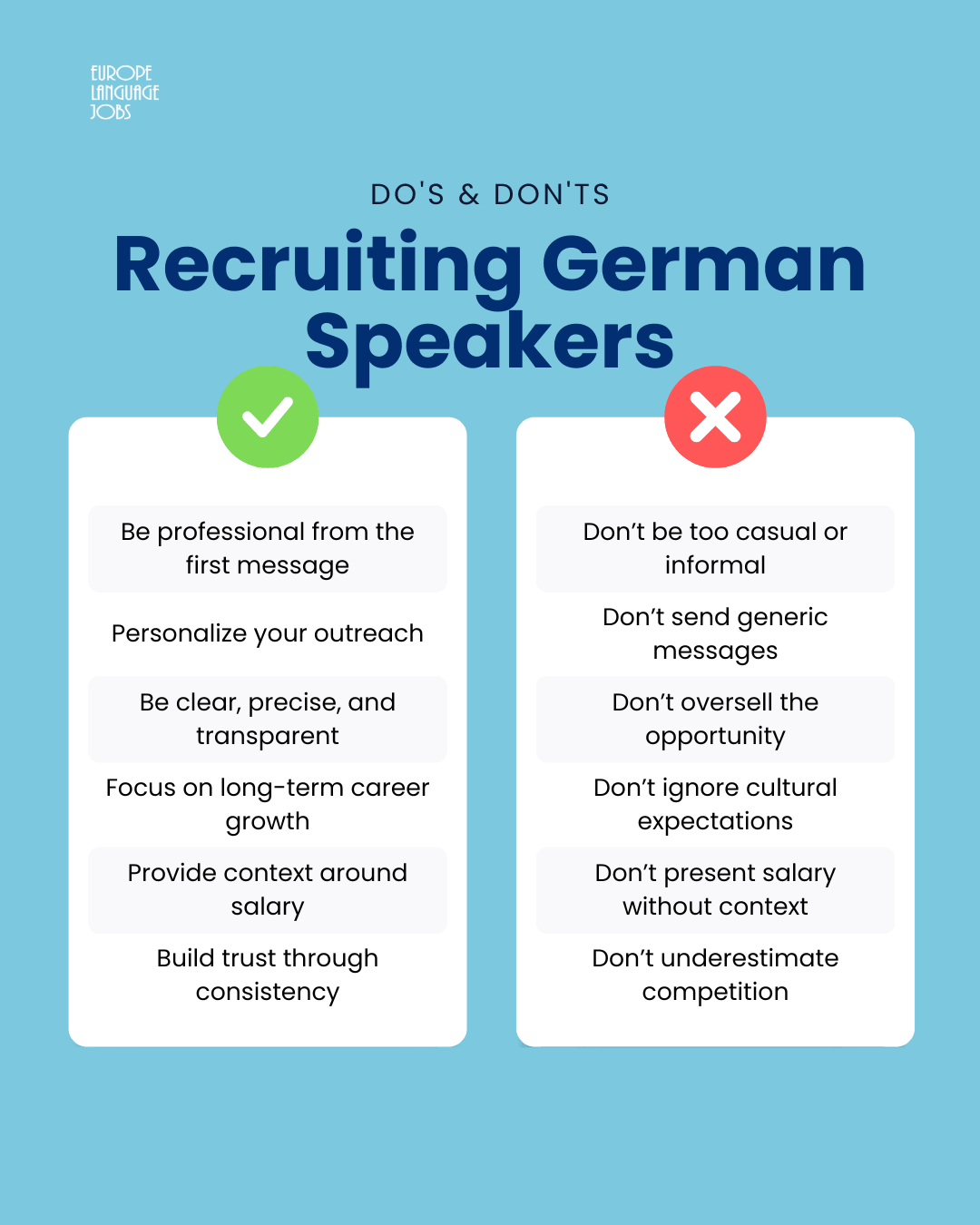
After having the opportunity to meet and speak with the Managing Director Yu Shimokawa, we included some practical do’s and don’ts of recruiting German speakers.
As she gained many insights on the German labour market after working for European business in the past years, Yu Shimokawa gave more clarity around this topic, helping HR teams build stronger, more effective relationships with this highly valuable talent pool. If you would like to listen to the whole conversation with her, you can do it here.
What makes German-speaking candidates different?
German-speakers that are seeking for job opportunities are often described as detail-oriented, structured, and highly reliable. While these traits may sound like general stereotypes, they have very real implications in recruitment.
Candidates from German-speaking markets tend to value precision, efficiency, and clarity in professional interactions. They are typically punctual, direct in communication, and expect the same level of professionalism from recruiters.
Unlike in some Mediterranean markets, where informal communication is quickly accepted, German candidates may initially maintain a more formal tone, especially in early stages of interaction, maintaining it for quite a long time afterwards.
Another important aspect is trust-building. German-speaking professionals often take more time to evaluate opportunities and the people offering them. However, once trust is established, the relationship tends to be stable and long-lasting as recruiters are aiming for the same.
For HR teams, this means that first impressions and early interactions carry significant weight.
Do: Adapt your communication style to earn trust
Having mentioned trust-building as an indispensable part of the hiring process, here is what you should remember about when building a relationship with your German candidates.
Professionalism is more essential than you presume
One of the most common mistakes recruiters make is approaching German-speaking candidates with overly casual communication styles. While this may work well in more Southern European markets where the communication style is more informal, it can be perceived as unprofessional or even disrespectful in this context for Germans.
Using formal titles such as Mr., Ms., or even Dr. (when appropriate) signals respect and awareness of professional norms. It also demonstrates that the recruiter has taken the time to research the candidate’s background and presence across online platforms, showing their genuine interest.
Therefore, professional communication, in this case, is not about being distant. It is rather about establishing credibility from the very first message.
Personalization beats automation
Another key factor in building trust within the process of hiring professionals from the German talent pool, is personalization.
German-speaking candidates are often exposed to a high volume of outreach messages, many of which are generic or clearly automated with AI tools. As a result, they tend to be more skeptical and picky of recruiter communication.
A generic message that lacks context or specificity is most likely to be ignored.
On the other hand, a well-crafted, personalized message that clearly explains:
-
why the candidate was selected
-
what the role involves
-
what makes the opportunity relevant
can significantly increase potential employees’ engagement.
In this talent segment, effort is noticed, and consequently rewarded. That is why, the personalization of messaging is not just a nice addition, but a fundamental requirement.
Don’t: Treat German candidates like any other talent pool
Many recruiters have the same common pitfall: applying the same outreach strategy across all markets. While this approach may save time, it often leads to poor results when targeting German-speaking professionals.
Usually, communication styles that are too informal, too vague, or overly sales-driven, which can create immediate disengagement. German candidates tend to prefer clear, fact-based communication flow over persuasive or emotional messaging.
That is the reason why recruiters who fail to adjust their approach may not receive direct rejection, but rather something even more challenging: ‘silent treatment’.
Thus, it is quite important for HR teams to understand that each market requires a tailored approach. In the case of German-speaking candidates, clarity, structure, and relevance outperform creativity and informality, as observed above.
Do: Highlight career growth, not just salary
Apart from the importance of the communication style when attracting German speakers, HR professionals should also pay close attention to how they present the job opportunity and what comes with it.
Career progression is a decision driver
While compensation is always an important factor, German-speaking candidates often place strong emphasis on career development and long-term progression.
This does not only refer to job titles or salary increases.
Candidates are particularly interested in:
-
how their responsibilities will evolve.
-
whether they will gain leadership or decision-making exposure.
-
opportunities for international experience.
-
access to structured learning and development.
Recruiters who clearly outline these elements position the role as a long-term professional investment, rather than just a short-term opportunity in the eyes of German job seekers.
Stability and long-term vision matter
A key difference that recruiters should acknowledge as well lies in how candidates evaluate stability. German-speaking professionals often look for roles where they can build continuity and predictability in their career path - and not only ensure a stable monthly income.
This means that sudden changes, unclear role definitions, or lack of long-term direction towards goals and growth can create hesitation.
Recruiters should therefore focus on presenting:
-
a clear organizational structure,
-
defined expectations,
-
a realistic long-term vision for the role.
In this context, stability is not perceived as a limitation, but mostly as a sign of professional maturity and organizational reliability.
Don’t: Oversell without substance
Overselling a position is one of the fastest ways to lose credibility with German-speaking candidates during the recruitment process.
Statements such as “fast career growth,” “dynamic environment,” or “exciting opportunity” may attract attention in other markets, but without concrete examples, they are often perceived as vague or even misleading, as said before.
German candidates tend to validate the information they receive. They may ask detailed questions, request clarification around some points of the job description, and carefully evaluate whether the promises made align with reality. In many cases, employment contracts are reviewed thoroughly before signing, sometimes even with legal support when it comes to German speakers.
For recruiters, this means that precision and honesty are far more effective than persuasive language. Providing clear, factual information builds trust and reduces friction in later stages of the hiring process.
Employer branding is not optional, it is expected
In the German recruitment landscape, employer branding is not a differentiator. It is a baseline expectation that German-speaking job seekers have.
Candidates often conduct their own research before engaging further in the hiring process. This includes reviewing company websites, social media presence, and employee feedback platforms. A weak or inconsistent online presence can raise concerns, even if the role itself is attractive.
However, employer branding in this context is less about visibility and more about consistency and credibility. German-speaking talent is not necessarily looking for highly polished or overly promotional content.
Instead, they value:
-
transparency about company culture,
-
realistic representation of the work environment,
-
alignment between what is communicated and what is experienced.
Therefore, recruiters need to remember that employer branding should focus on building trust rather than attracting attention when speaking of recruiting German talent.
Salary expectations: context is more significant than numbers
Germany remains one of the most stable economies and highest-paying labour markets in Europe, particularly for qualified professionals. However, salary expectations cannot be understood in isolation when it comes to hiring German speakers abroad.
German candidates are typically very aware of how compensation is structured in their home country, including taxes, social contributions, and benefits. This awareness influences how they evaluate offers abroad.
When considering international opportunities, German-speaking professionals do not simply compare gross salaries.
They assess the overall value of the offer, including:
-
net income after taxation,
-
cost of living in the destination country,
-
financial stability and predictability.
This is where many recruiters across Europe face challenges. A lower nominal salary may still represent a strong opportunity. However, only if the context is clearly explained to the candidate.
Providing this salary context is not about justifying the offer. It is about helping the candidate make an informed decision, based on the economic background of the foreign country. Recruiters who take the time to explain these factors position themselves as trusted advisors rather than negotiators.
Competition for German talent as the real challenge
One of the defining characteristics of the German job market is its competitiveness from the employer’s perspective. Skilled German-speaking professionals often have access to multiple opportunities, both in their home country and internationally.
At the same time, only a relatively small percentage of candidates actively consider relocation abroad. This creates a situation where demand exceeds supply, as the unemployment rate of Germany is already low, and competition between employers becomes pretty intense.
In this environment, success in recruitment depends less on volume and more on precision and relevance. Recruiters must:
-
approach the right candidates,
-
communicate the right message,
-
provide the right level of detail.
In such a competitive landscape as the German one, generic recruitment strategies rarely show any success.
Recruiting German speakers is about trust, not just offers
On the whole, recruiting German-speaking talent is not simply about presenting an attractive job offer. It is about building a relationship between HR specialist and candidate, based on clarity, professionalism, and mutual respect.
Professionals in this market value structured communication, transparent information, and long-term thinking. They expect recruiters to be prepared, precise, and aligned with their expectations from the very beginning.
Ultimately, the recruiters who succeed are not those who try to “sell” opportunities, but those who earn trust through consistency and credibility.
In a highly competitive talent market, trust is not just an advantage - it is the deciding factor!