






All expats know that moving abroad always comes with a bit of a cultural adjustment: new food, new habits, different ways of communicating, and last but not least, very diverse ways of working and living together.
That being said, if you’ve ever shared a flat, worked in an international team, or simply spent time around Germans abroad, you’ve probably noticed a few things that feel a little different from normal at first.
The truth is that Germans have some habits that might even surprise you in the beginning. But after some time, many expats realize that this is the beauty of getting to meet with international people, and that these cultural differences actually make daily life easier and more organized, if looking at it from another perspective.
So, what is it really like living with Germans or working alongside them abroad? Let’s talk about it in the following blog article!
What's it like working and living with Germans abroad?
One of the first things people notice when living with Germans abroad is how structured and organized their daily routine can be. That much, that sometimes it is a bit of a burden for the others.
Whether it’s in a shared apartment, a coworking space, or an international office workspace, Germans often bring a strong sense of responsibility and reliability into their everyday life. Their plans are usually made way in advance, communication tends to be clear, and people generally respect each other’s time and space.
At first, this can feel a little intense for people coming from more spontaneous or relaxed cultural backgrounds. However, after some time, many expats that get to share their daily life with Germans start appreciating how much easier things become when expectations are communicated clearly.
Therefore, only when living with Germans, you quickly realize that many of their habits are not about being strict. They’re rather simplifying the daily routine by creating stability, fairness, and efficiency for everyone around them.
Things Germans do that might surprise you abroad
Speaking of small daily habits that would definitely facilitate your life if there is a German presence in it, here some of them that might surprise you:
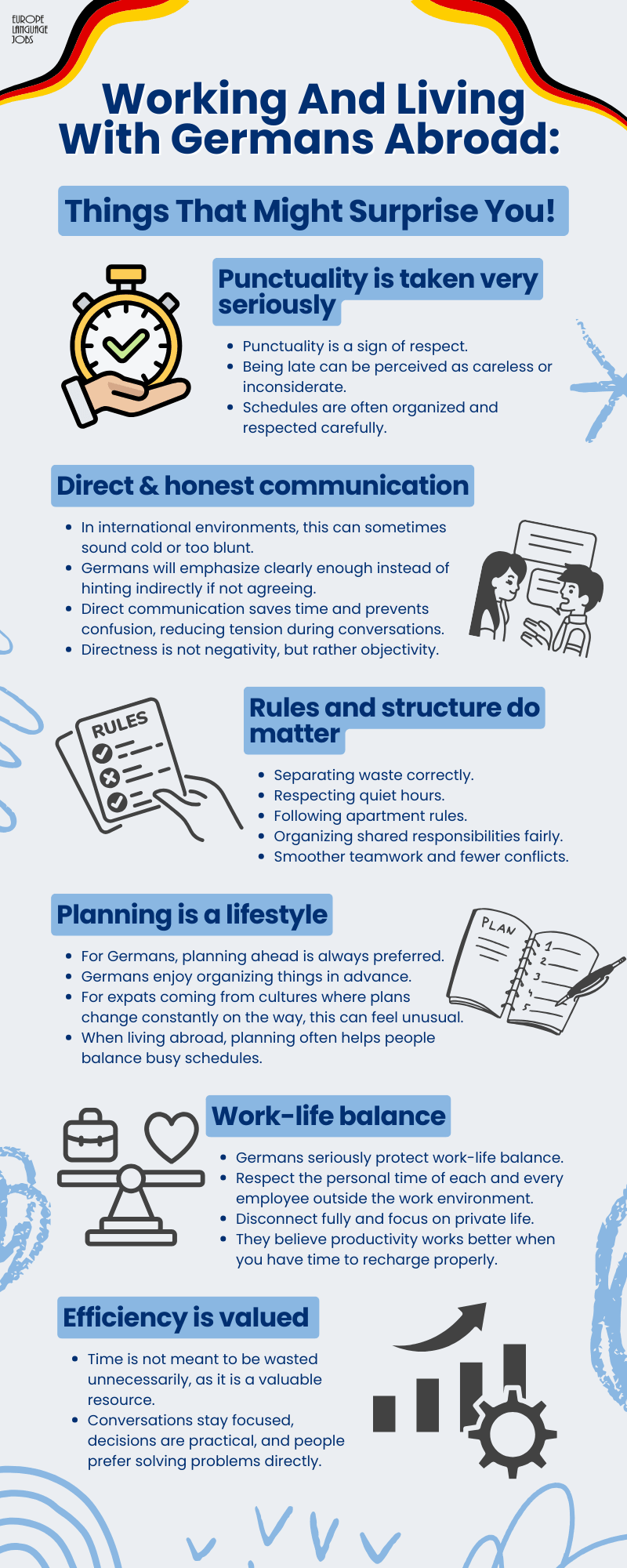
Germans take punctuality very seriously
If a German says they will arrive at 18:00, they usually mean exactly 18:00...or even a few minutes prior.
For many Germans, punctuality is a sign of respect. Being late, even by a few minutes, can sometimes be perceived as careless or inconsiderate, especially in professional environments.
This German norm applies not only to work meetings, but also to social plans, shared financial and alimentary responsibilities in apartments, or even online calls.
When living with Germans abroad, you may notice that schedules are often respected carefully. Cleaning plans, rent payments, grocery shopping, or shared apartment responsibilities tend to follow clear organization that is listed at least a week prior.
At first, this level of structure might feel surprising for other nations, but it often helps avoid misunderstandings and unnecessary stress later on.
They communicate directly and honestly
One of the biggest cultural shocks for many expats is the direct communication style that Germans have at ease.
In general, they are very honest and straightforward. That is why if they dislike something or someone, they will usually say it or emphasize clearly enough instead of hinting indirectly.
In international environments, this can sometimes sound cold or too blunt at first. But in reality, it’s rarely meant in a rude way by true Germans.
For them, direct communication saves time and prevents confusion. Instead of making people guess what they really mean, they prefer being transparent from the beginning.
When working and living with Germans abroad, understanding this communication style makes interactions much easier, having less tension during the conversations. Once you stop interpreting directness as negativity and you start perceiving it as objectivity, you often realize it creates more clarity and trust between you.
Rules and structure matter more than you think
In case you’re wondering, yes! The stereotypes about recycling are true!
Many Germans grow up in environments where rules and systems are taken seriously in their home country. This can appear in surprisingly small everyday situations:
-
separating waste correctly,
-
respecting quiet hours,
-
following apartment rules,
-
organizing shared responsibilities fairly.
When living with Germans, you may notice that they feel more comfortable when expectations are clearly defined rather than when chaos is thriving in their daily self-organization.
The same happens in professional environments: processes, deadlines, and responsibilities are usually communicated carefully and followed seriously afterwards by all members of the team.
While some people from around the world initially see this as overly strict, it often creates smoother teamwork and fewer conflicts in the long run between colleagues.
Planning is a lifestyle
We could say that for Germans spontaneous plans definitely do exist. However, a bit of planning ahead is always preferred.
Many Germans enjoy organizing things in advance, whether it’s holidays, dinners, meetings, or weekend activities with friends or family.
For expats coming from cultures where plans change constantly on the way, this can feel unusual at first, and sometimes even quite frustrating. But in the meantime, there’s also something comforting about knowing what to expect, right?
When living abroad, planning often helps people balance busy schedules, work responsibilities, and personal life more effectively.
And honestly? After some time, many expats start becoming more organized themselves. Therefore, the German way really does help!
Work and personal life stay separate
Another thing that surprises many people when working with Germans abroad is how seriously they protect work-life balance. But not only: they also try to keep a strict line between work life and their personal life as two completely different worlds.
It is a common practice in Germany to respect the personal time of each and every employee outside the work environment. Once the workday ends, people usually disconnect fully and focus on their private life, family, hobbies, or rest.
It’s less common to see a culture of constantly answering emails late at night or staying available 24/7.
But do not get the wrong idea. This doesn’t mean Germans care less about work. Quite the opposite: they simply believe productivity works better when people also have time to recharge properly, having a life outside the four walls of their office.
For many expats, this mindset becomes one of the most positive things they learn abroad from living with Germans and getting to “steal” some of their daily habits.
Germans value efficiency in everything
When Germans have meetings preplanned and organised, they always have to have a purpose. Therefore, tasks are approached methodically and time is not meant to be wasted unnecessarily, as it is considered to be a valuable resource.
That is why efficiency is deeply connected to both German work culture and daily life.
When working with Germans abroad, you may notice that conversations often stay focused, decisions are practical, and people prefer solving problems directly instead of discussing them endlessly as other cultures have it as a habit.
At first, this can feel a little intense in international teams. But over time, many people appreciate how productive and organized the environment becomes because of this simple change.
Why do these habits actually make working and living together easier?
Even if some German cultural habits feel surprising at first, in reality many of them actually make shared living and teamwork much smoother for everybody:
-
Clear communication reduces misunderstandings.
-
Respect for time builds trust.
-
Organization helps avoid chaos in both apartments and workplaces.
When people in a shared community know what to expect from each other and have mutual respect, daily life becomes way much easier.
This is why many expats who initially struggle with these slight German cultural differences eventually end up appreciating them the most.
What can you learn from working and living with Germans abroad?
Living abroad is always an opportunity to learn from different cultures and shape your personality by combining all experiences. That being said, living with Germans is no exception in this case.
To be more organised
Germans remind us that at the end of the day, yes, you don’t need to schedule every minute of your life.
However, being a little more organized can reduce your stress and anxiety levels, but also improve your communication with others around you.
To communicate clearly
A big and very helpful key point that could be taken out from German daily habits is that saying things openly and honestly often prevents bigger misunderstandings later.
We all know that clear communication may feel uncomfortable at first, but it usually makes relationships healthier and more transparent, but also prevents a lot of misunderstandings in the long-term.
To respect shared spaces
Another aspect that you might get from coexisting or living with Germans, is the mutual respect. Whether it’s a shared apartment or an office kitchen, respecting common spaces makes life easier for everyone involved.
That proves that yes, small habits really do matter!
To set healthy boundaries
Last but not least, Germans are teaching us one of the best lessons: resting is important too and we are all allowed to do it.
Protecting your personal time out of work and your private life does not make you lazy. Quite the opposite: it helps you stay productive and balanced long-term.
Different doesn’t mean difficult
Working and living with Germans abroad can feel surprising in the beginning, especially if you come from a very different cultural background.
However, most of these habits are not about being cold, strict, or distant. They are simply different ways of existing by creating structure, respect, and balance in everyday life.
And that’s one of the best parts of living abroad: discovering new perspectives and slowly realizing that the habits that surprise you the most are sometimes the ones you end up adopting yourself.