






Hiring Dutch speakers can feel like a challenge,and honestly, it is. But the key is not to do more, it’s to do things differently and adapt the approach.
Dutch candidates are highly skilled, selective, and often not actively looking to leave their country. If you want to attract them, your approach needs to be intentional, transparent, and relevant to what they actually value.
To understand what really sets Dutch talent apart, it helps to look at it from the inside. In a recent HRtalks webinar, Europe Language Jobs experts shared some practical insights about the Dutch job market and what candidates truly expect.
Why Dutch Speaking Jobs Are So Hard to Fill
Dutch is a relatively small language globally:
-
around 23 million native speakers,
-
approximately 4 million second-language speakers.
Most native speakers are concentrated in the Netherlands and the northern part of Belgium, which already limits geographical reach. But what really makes a difference is the strength of the local job market.
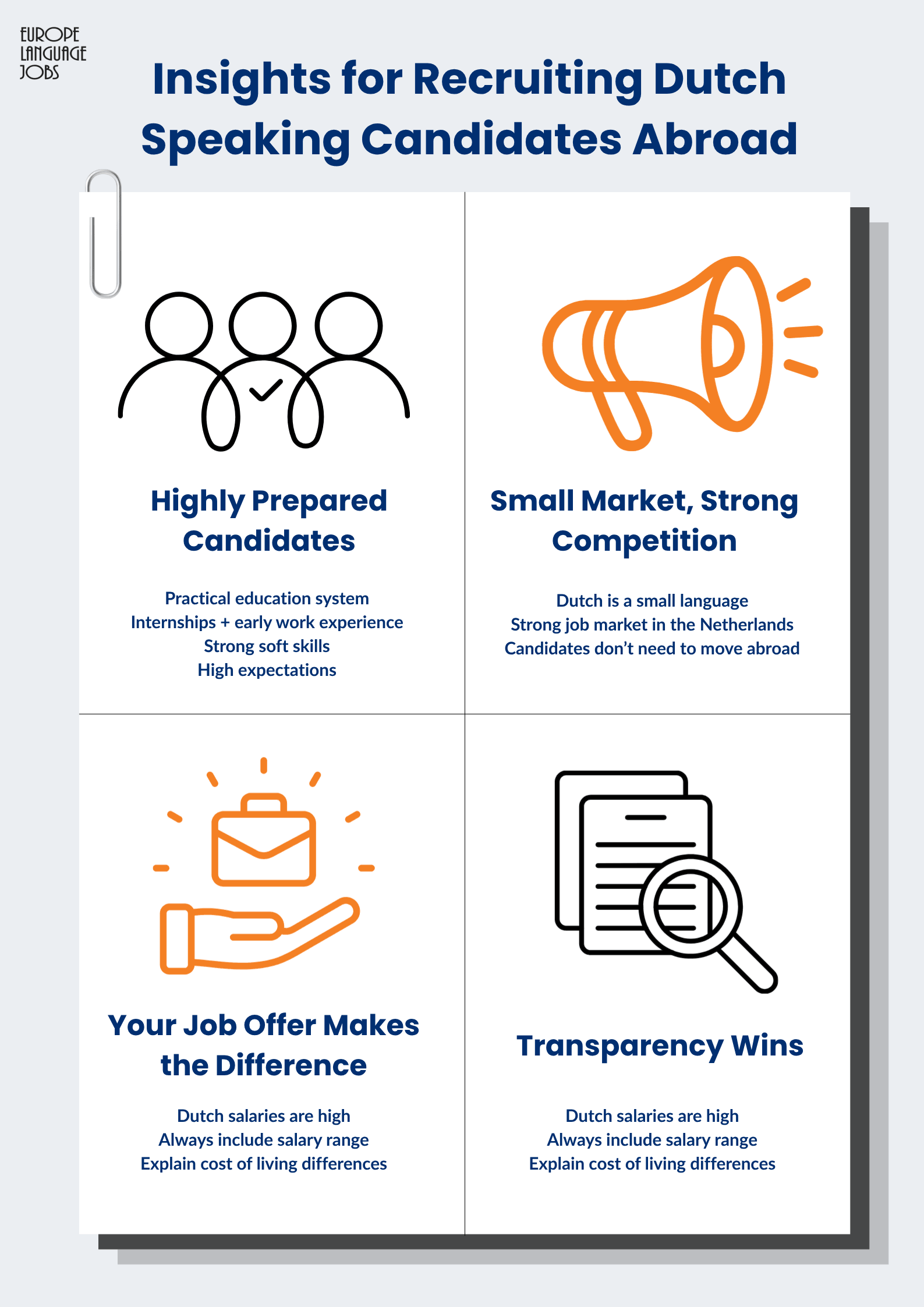
The Netherlands has one of the lowest unemployment rates in Europe. There are nearly as many job openings as there are job seekers, more exactly, at the end of 2025 there were 97 job openings for every 100 unemployed people. In practice, this means Dutch candidates already have access to strong opportunities at home, often with real competitive salaries and very good working conditions.
If you are currently hiring, you can explore how your roles compare with existing Dutch speaking jobs available across Europe and better understand what candidates are seeing in the market.
So when companies try recruiting Dutch speakers abroad, they are not competing against unemployment, they are competing against comfort, stability, and familiarity.
In simple terms: Dutch candidates don’t need to leave their country to find a good job.
That’s why recruiting Dutch speakers abroad requires a very different strategy.
Understanding the Dutch Job Market. A Highly Practical Education System & Early Career Preparation
Dutch candidates stand out largely because of how prepared they are for the job market.
This preparation starts early. Career guidance is introduced already in high school, where students learn how to build a CV, write cover letters, and identify their strengths and weaknesses.
The education system in the Netherlands puts a strong focus on practical experience. It is not only about theory, but about understanding how work actually functions. Internships are often mandatory, and universities collaborate closely with companies, giving students early exposure to real professional environments.
It’s also common for students to receive job offers before they even graduate.
The key practical characteristics the educational system in the Netherlands include:
-
internships (often mandatory),
-
group work and real-life projects,
-
career coaching (CVs, strengths, direction),
-
early work experience (sometimes from the age of 14, which creates a culture where work experience is part of growing up).
The Dutch education system focuses heavily on practical experience, not just theory..
This is the reason why Dutch candidates enter the job market with strong soft skills. Communication, problem-solving, adaptability, and critical thinking are already developed by the time Dutch candidates have finished their studies. Naturally, this level of preparation comes with higher expectations. Why? Because students who graduated in the Netherlands invested a lot in their education and they know they are qualified. So, it’s more than normal to desire a workspace that balances all the effort they put so far in their own development, financially and not only.
What Dutch Candidates Look for in Jobs Abroad
Since most Dutch candidates already have access to strong opportunities at home, relocation is rarely about necessity. It is about choice.
For many, moving abroad is driven by a desire for change. A different lifestyle, better weather, a more social environment, or simply the experience of living in another country can be strong motivators. Southern European destinations such as Spain, Portugal, Greece, and Italy are especially attractive for this reason.
Personal development also plays a role. Candidates may be looking to gain international experience, develop new skills, or step outside of their comfort zone. In some cases, mentorship opportunities or a different work culture can also be a deciding factor.
Since COVID, another trend has become more visible: the gap year after university. During this period, many young Dutch candidates are more open to relocating. They are not necessarily looking for long-term stability, but rather for experience. This makes them more flexible and more willing to explore opportunities abroad.
For employers, this is an important window. Especially when targeting junior profiles, timing can make a big difference.
How to Attract Talent for Dutch Speaking Jobs in Spain and Barcelona
When it comes to attracting Dutch talent, location plays a key role, especially in Southern Europe.
Countries like Spain are particularly appealing due to lifestyle factors such as climate, culture, and social life. Cities like Barcelona already have a strong international environment and a visible Dutch-speaking community, which makes relocation feel more accessible.
If you want to understand what candidates are currently exposed to, it’s useful to explore active Dutch speaking jobs in Spain and see how companies position their offers.
More specifically, cities like Barcelona continue to attract candidates looking for both lifestyle change and professional opportunities, which is reflected in the demand for Dutch speaking jobs in Barcelona.
However, lifestyle alone is not enough. Candidates need to clearly understand what they gain from the move. This includes transparency around salary, but also how that salary translates into actual quality of life.
Many Dutch candidates are not used to comparing salaries internationally. A lower salary abroad may still provide a comfortable lifestyle, but this needs to be explained clearly during the recruitment process.
How to Write Job Offers That Convert Dutch Candidates
The job description is often underestimated, but it plays a crucial role in Dutch recruitment strategies.
It is the first impression a candidate has of your company, and it can determine whether they will apply or not.
Strong job offers usually have a few things in common:
-
clear and transparent salary information,
-
well-defined responsibilities and expectations,
-
specific and realistic benefits,
-
no spelling mistakes or vague wording.
Transparency is particularly important. Job offers that include salary ranges consistently perform better than those that don’t.
Benefits also need to be clearly explained. Instead of using generic phrases, it’s more effective to show what candidates actually get. For example:
-
access to courses or mentorship (if you name them it’s even better) instead of “career growth”,
-
team activities (what kind of activities?) or flexible schedules instead of “great environment”,
-
fitness center subscription and access to different clubs instead of “benefits”,
-
lunch card or allowance for lunch meals is also a great benefit (if you provide that, name it!),
-
instead of saying “sunny weather 300 days per year”, which is something you can’t really control, you can emphasize an activity that the company offers by the benefit of the good weather, such as a run club or surfing lessons, depending on the location.
Relocation support is another key factor. Even if financial support is not available, providing guidance on documents, housing, or administrative steps can significantly increase applications. Explain the process, give tips, advice, tell them what documents they need, where they need to go. This costs nothing, but it helps a lot.
Remote Dutch Speaking Jobs vs Relocation: What Candidates Prefer
While relocation remains attractive, especially for younger candidates, flexibility has become increasingly important.
Some candidates prefer to stay in the Netherlands while working remotely, while others are open to relocating but still expect flexible working conditions.
You can see this shift reflected in the growing interest in remote Dutch speaking jobs, which offer international opportunities without requiring relocation.
That said, many candidates, especially those taking a gap year, still value the full experience of living abroad. For them, relocation is part of the appeal.
Common Mistakes when Recruiting Dutch Speakers
The job description is often underestimated, but it plays a crucial role in Dutch recruitment strategies.
It is the first impression a candidate has of your company, and it can determine whether they apply or not. Even small mistakes can reduce your chances of attracting Dutch talent.
Some of the most common mistakes that should be avoided in the recruitment process include:
-
lack of transparency, especially around salary,
-
job description is too short and unclear,
-
generic, AI-like content that feels impersonal and obviously not written by a human,
-
not taking into consideration employer branding (you need to look trust-worthy and professional on your online platforms, especially if the job needs relocation)
-
overpromising benefits, also not listing any of them,
-
spelling mistakes.
Candidates, especially younger ones, can easily recognise when a job offer feels generic or low effort. This can create distance and reduce engagement.
Key takeaways
If there’s one thing to take away, it’s this: Dutch candidates are not difficult to hire. They are just used to a very high standard. And they expect that standard to be met.
So before trying to “improve” your hiring process, it’s worth stepping back and asking a simple question: does our offer actually make sense for them?
Companies that succeed in Dutch talent recruitment usually focus on a few key things:
-
they understand what their candidates are looking for,
-
they communicate clearly and transparently,
-
they offer realistic and well-defined benefits,
-
they present opportunities, both professional and personal experiences.
In the end, what makes the difference is simple: a clear offer, a strong message, and a reason that truly feels worth the move.