






Hiring Dutch-speaking talent has become a priority for many companies across Europe, especially those building multilingual teams or expanding into international markets. However, despite the demand, many employers still struggle to achieve consistent results when recruiting Dutch candidates.
At its core, talent acquisition is about finding the right people and convincing them to choose your company. It’s not just about filling a vacancy quickly, but about building a process that consistently attracts candidates who are a good fit and likely to stay.
In competitive markets like the Dutch one, where candidates often have multiple options, a strong approach to talent acquisition can make the difference between hiring successfully and losing candidates along the way.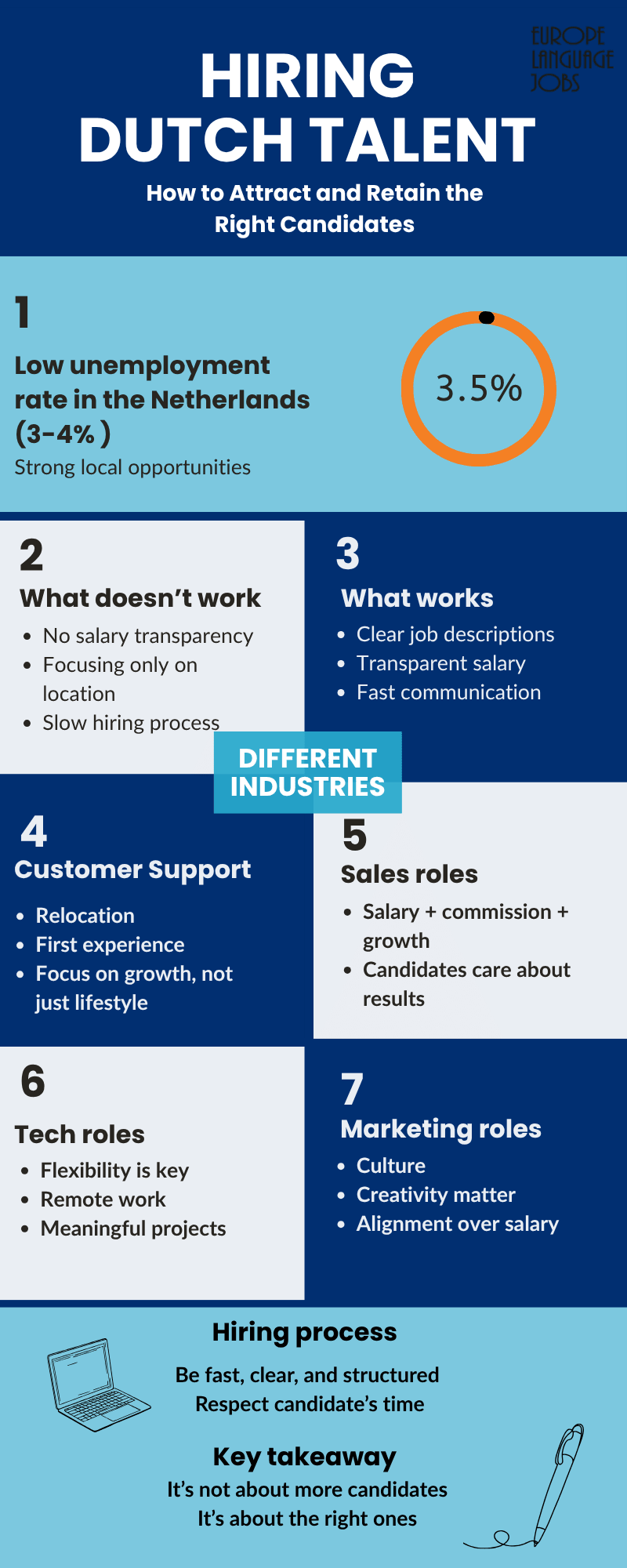
How recruitment works in the Netherlands (and why it feels different)
To successfully recruit Dutch-speaking talent, it’s important to understand that the hiring process in the Netherlands can look differently from many other European markets. What may work in Southern or Eastern Europe, or even in larger markets like Germany, does not always translate effectively when targeting Dutch candidates.
One of the key differences lies in how structured and transparent the recruitment process is expected to be. Dutch candidates are used to:
-
clearly defined roles,
-
well-organised hiring stages,
-
straightforward communication from the very beginning.
Job descriptions are typically detailed, salary ranges are usually included, and expectations around responsibilities, working hours, and team structure are made explicit early on. When this clarity is missing, candidates are more likely to disengage quickly.
Understanding Dutch Talent Market
Salary is not a benefit, it’s the baseline
For Dutch candidates, salary is often the single most important factor when evaluating a job. It’s not seen as a “nice to have” or something to negotiate later, but as a basic requirement that must be clear from the start. Job offers without a visible salary range are far more likely to be ignored, regardless of how attractive the role or location may seem.
Communication style
Another important factor is the relatively informal yet highly efficient communication style. While the process itself is structured, the tone is not overly formal. Dutch candidates value directness and honesty over politeness or corporate language. Recruiters are expected to “get to the point” quickly, avoid vague statements, and provide realistic answers, even if they are not necessarily positive. In many cases, a short and clear message will be perceived as more professional than a long, overly polished one.
Compared to other markets, hierarchy plays a less dominant role in Dutch workplaces. This is reflected in recruitment as well. Interviews are often conversational rather than interrogative, and candidates may challenge assumptions, ask a lot of questions, or openly express concerns. This is not a sign of disinterest, but rather a way of evaluating whether the role and company are truly the right fit.
Market Competitiveness
The Dutch job market is also highly candidate-driven. With low unemployment and strong local opportunities, candidates are not under pressure to accept the first offer they receive. Instead, they tend to compare options carefully and prioritise roles that align with both their professional goals and personal lifestyle.
Speed, clarity, and trust in the hiring process
Dutch professionals expect a process that is respectful to their time, with clear next steps and timely communication after each stage. Each step can be clearly defined and recruiters should be mindful and respond to candidates in a timely manner.
In practice, this means that companies hiring Dutch talent not only need to adapt what they offer, but also how they communicate and structure their recruitment process. Success in this market depends less on attracting attention, and more on building trust through clarity, consistency, and realistic expectations from the very first interaction.
How to Hire the RIGHT Dutch Candidates based on your industry
When hiring Dutch-speaking talent, one of the most common mistakes companies make is applying the same recruitment strategy across all roles.
A strategy that works for customer support roles, for example, will not work in tech, sales, or specialist positions. For this reason, attracting the right Dutch candidates starts with understanding how motivation, expectations, and decision-making differ across industries.
Customer support and BPO roles: focus on lifestyle and accessibility
Dutch candidates, particularly early-career professionals, evaluate opportunities based on more than location alone (which is also very important), prioritising development and work-life balance.
For high-volume roles such as customer support or back-office operations, the target group often includes younger candidates or professionals at an early stage in their careers. While this group is generally more open to relocation, they are also more likely to leave if the role does not meet their expectations.
To attract the right candidates, companies should:
-
clearly explain daily tasks, KPIs, and workload,
-
avoid overselling lifestyle benefits,
-
position the role as a starting point for an international career, not just a short-term experience.
Candidates who see the role as a stepping stone are significantly more likely to stay than those motivated purely by location.
Sales roles: attract candidates driven by performance and growth
When hiring Dutch speakers for sales roles, such as SDRs (Sale Development Representatives) or account managers, motivation shifts towards performance, earnings, and career progression. Meaning that Dutch candidates applying for sales roles are not mainly interested in lifestyle or relocation, they are focused on results, salary and growth.
How to attract the right profiles:
-
be transparent about salary, commission structures and targets,
-
highlight career growth opportunities,
-
emphasize autonomy and ownership.
One useful tip shared by Dominic Monkhouse (Business Coach) is to ask candidates to sell to you during the interview. It’s a simple way to see how they think, communicate, and handle real situations, especially for sales roles.
Tech and specialist roles: prioritize flexibility and meaningful work
For IT, engineering, or other specialist roles, attracting Dutch talent becomes even more competitive, because these candidates have strong local opportunities and are less likely to relocate unless the offer provides clear added real value. Even if you’re in the process of finding the right Dutch candidate in the Netherlands or in another country, the following points are important to exist in each situation.
Companies should focus on:
-
interesting and meaningful projects,
-
long-term career development,
-
work-life balance.
Dutch candidates expect clear added value to the local salary. If the job in question needs relocation, keep in mind that Dutch candidates will only consider a move if the role offers real value in how they work, what they work on, and how they can grow. Without this, even attractive locations are not enough to convince them.
Marketing and creative roles: alignment over salary
For marketing and creative positions, attracting the right Dutch-speaking candidates requires a different approach. In these roles, salary is important, but it is rarely the only deciding factor. Candidates often place strong emphasis on company culture, values, and the overall working environment, as these directly impact their ability to perform, collaborate, and grow. This is why companies and recruiters should also focus on skills, motivation, and learning ability.
To attract candidates who would truly match your company, it is essential to:
-
communicate your company culture clearly and authentically,
-
show how teams collaborate and how ideas are shared,
-
highlight ownership, responsibility, and creative freedom in the role.
Creative and marketing professionals are typically drawn to environments where they can see the impact of their work. According to insights from Forbes, employers hiring for creative roles should prioritize traits such as curiosity, adaptability, collaboration, and the ability to think independently.
Why some Dutch hiring strategies don’t work
Many companies struggle to hire Dutch talent not because of a lack of candidates, but because their approach is misaligned with how Dutch professionals evaluate opportunities.
In today’s market, candidates are more selective than ever. Insights shared by industry professionals and companies operating in the Netherlands highlight a growing challenge: a gap between what companies offer and what candidates actually expect. This means that even when companies attract applicants, they often fail to convert them into the right hires.
Because of this, certain recruitment approaches can quickly become ineffective. It can feel like a “trap” when companies:
-
focusing on attracting as many candidates as possible instead of the right ones,
-
focusing too much on the location instead of the role,
-
not including salary transparency in job offers,
-
using slow or unclear hiring processes,
-
applying the same recruitment strategy across all domains and positions.
Companies that succeed in the Dutch market are those that adapt their strategy to candidate expectations, rather than relying on traditional recruitment approaches.
These strategies may generate applications, but they often fail to convert into successful hires. In a market where candidates have strong alternatives, attracting attention is not enough. What matters is attracting candidates who are actually aligned with the role.
If you approach Dutch hiring challenges as a chance to improve your strategy, rather than as a limitation, you can build an organization that is better positioned to attract and retain the right talent over time.
What to take away?
Hiring Dutch talent can feel hard, but the solution isn’t to do more, it’s to do things differently.
Generic approaches simply don’t work, and the sooner you recognise that, the easier it becomes to adjust your strategy. In the end, this benefits both sides: companies attract better-fit candidates, and candidates find roles that actually suit them.
What really makes the difference is how well your offer matches what candidates are looking for. Whether it’s being transparent about salary, clear in your communication, or adapting your approach depending on the role, every step of the process influences who you attract and who you lose.