






During Pride Month, many companies show support for the LGBTQ+ community through campaigns, events, and internal initiatives. While these efforts are important, creating a truly inclusive workplace requires year-round commitment. This is where diversity management plays a key role.
Pride Month often encourages employers to reflect on inclusion and representation. However, true good diversity management and inclusion practices goes beyond a single month of awareness campaigns. It’s shown in the way your company works, how your employees feel and how it’s reflected in their work and well-being at the office.
Companies that actively invest in diversity management are often better positioned to attract talent from different backgrounds, cultures, and experiences. Whether you're looking to strengthen your employer brand or reach a more diverse pool of candidates, understanding how to effectively hire international and multilingual talent can be an important part of creating a truly inclusive workplace.
What Is Diversity Management in the Workplace?
Think about diversity management as a tool. A strategic approach to build a work environment that values and appreciates differences within the individuals. It’s about promoting inclusion of employees across their backgrounds. Every person that takes part of the organization is bringing something to the table in an unique way, exactly because of their different previous contexts.
However, diversity management is more than just hiring people with different backgrounds. Managing diversity means to actually implement programs and guidelines in order to create this inclusive environment at the workplace. To promote greater inclusion means to develop a work environment where employees of different age, gender, race, sexual orientation, disabilities and backgrounds - feel valued, respected and equal.
Effective diversity management also involves identifying and removing barriers that may prevent employees from reaching their full potential. This can include reviewing recruitment processes, ensuring equal access to training and career development opportunities, promoting inclusive leadership, and encouraging open communication across teams. The goal is to create a workplace where everyone has the opportunity to contribute, grow, and succeed based on their skills and performance.
Why Diversity Management Matters Beyond Pride Month
First of all, diversity management is not a seasonal campaign. It’s something that should exist all the time in your workplace, because you value your employees and you want them to always feel that their work is recognized and valued. Their work, but them just as humans as well. To create a truly inclusive workspace is not only moral to your people, it’s essential to create a real place where people can give the best they have because they feel like it’s the right setting to do that. The management should be aware of the fact that employees’ satisfaction and well-being comes from different places and each one of them influences how they perform.
However, limiting diversity, equity, and inclusion (DEI) efforts to Pride Month can result in performative "rainbow-washing”. A working environment that is truly inclusive and cares about being inclusive won’t use only the Pride Month to show their audience and their employees that they value and support diversity. Pride Month is, for sure, a good chance to make visible the support that the employer has for inclusion. Nevertheless, we believe there is a thin line between putting a lot of effort into showing it only in June and actually demonstrating actively through the organizational culture how they look after the people.
People thrive when and where they feel safe enough to be themselves. This is named psychological safety at the workplace, in our context. While Pride Month encourages important conversations about representation and equality, creating an inclusive workplace shouldn’t be limited to a single month of the year. Employees experience company culture every day through their interactions, opportunities, and sense of belonging. Diversity management helps organizations ensure that inclusion is embedded into everyday practices rather than treated as a seasonal initiative.
Diversity Management - A New Organizational Paradigm
A paradigm is a way of thinking. Diversity management as a new organizational paradigm refers to the fact that companies are changing the way they think about employees, talent, leadership and business success, within the inclusion approach..
In the past, many organizations believed that:
-
employees should adapt to the company;
-
everyone should work in similar ways;
-
diversity was mainly viewed as a legal requirement;
-
inclusion was rarely discussed;
-
recruitment often focused on finding people who “fit the culture”.
The new paradigm the today’s workforce intends to recognize is about:
-
having diverse teams bring different perspectives;
-
employees having different needs and experiences;
-
companies can benefit from attracting talent from different backgrounds and countries.
Instead of asking "How can people fit into our company?", companies are more asking:
"How can we build a workplace where different people can succeed?"
That shift in thinking is what researchers call a new organizational paradigm.
In today's increasingly global workforce, diversity management has become an important part of organizational success. Companies that embrace workplace diversity often benefit from a wider range of perspectives, improved creativity, stronger collaboration, and a better understanding of diverse customer groups. When employees feel included and supported, they are also more likely to be engaged, motivated, and committed to the organization, contributing to a stronger company culture overall.
Diversity management is becoming increasingly important as more companies expand their international recruitment efforts and hire talent from different countries and cultures. Whether an employer is recruiting for jobs abroad, building multilingual teams, or filling positions such as jobs in Spain for German speakers, creating an inclusive workplace is essential for attracting and retaining diverse talent. Employees are more likely to thrive in organizations where they feel respected, supported, and able to contribute their unique perspectives, regardless of their background or identity, says a study on how these practices translate into reality.
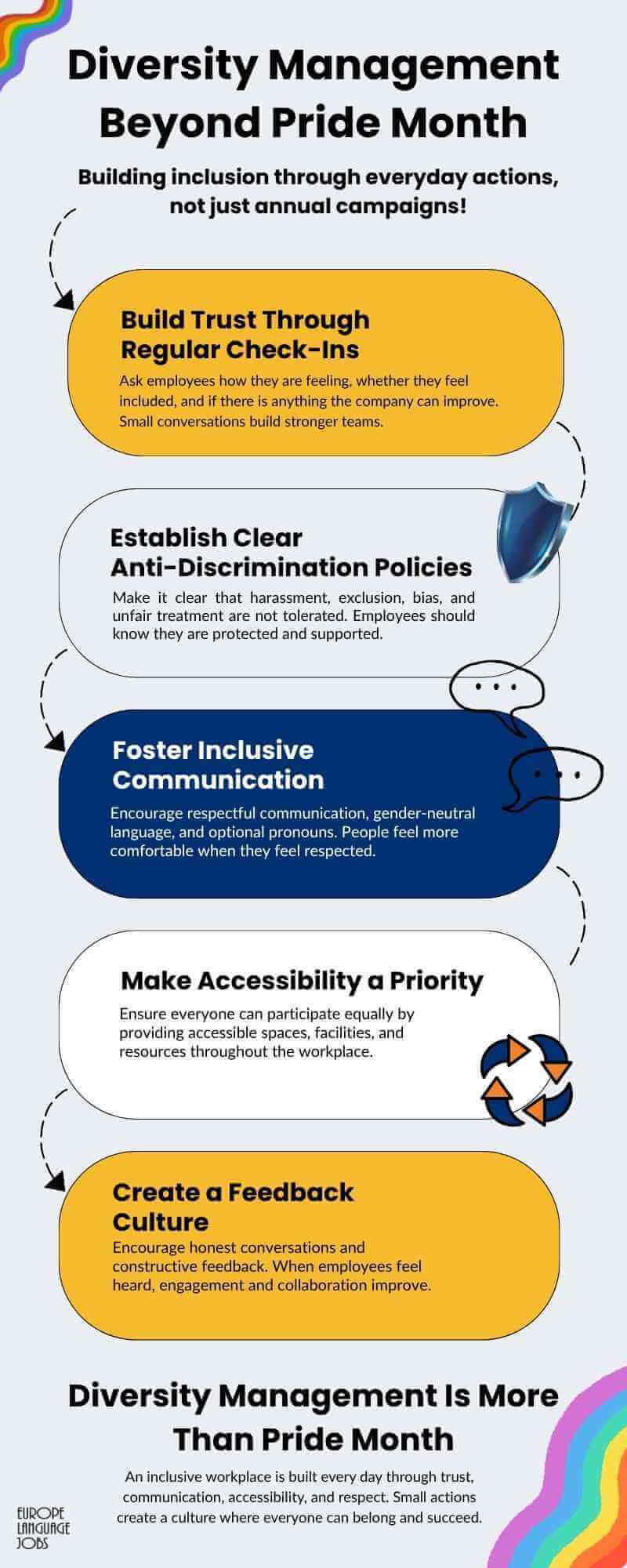
5 Diversity Management Strategies for a More Inclusive Workplace
We mentioned psychological safety earlier in the article, and this section is strongly connected to it. A truly inclusive workplace is not created only through big statements or one-time campaigns. It is built through daily actions, clear policies, accessible spaces, and a company culture where employees feel safe to be themselves.
The following diversity management strategies can help employers create a more inclusive workplace, especially within multicultural and multilingual teams.
-
Building trust and check in with employees frequently
Diversity management is not only about policies and programs. It is also about relationships. Employees are more likely to feel included when they trust their managers and know that someone cares about their experience at work.
Regular check-ins give managers the opportunity to understand how employees are feeling, whether they need support, and if something is affecting their sense of belonging.
For example, a manager can ask:
-
“How are you feeling in the team?”
-
“Is there anything making your work more difficult at the moment?”
-
“Do you feel included in meetings and decisions?”
-
“Is there anything we can improve to support you better?”
Effective management is not only about overseeing performance but also about understanding employee experiences and creating opportunities for meaningful conversations. In larger organizations, a dedicated diversity manager may help coordinate these efforts and ensure inclusion remains a priority.
-
Establish clear anti-discrimination policies
A company cannot build an inclusive workplace if employees are not clearly protected against discrimination. Anti-discrimination policies should explain what behavior is not acceptable and what employees can do if they experience or witness discrimination.
This includes discrimination based on gender, sexual orientation, race, ethnicity, nationality, religion, disability, age, or any other personal characteristic.
For example, the policy should clearly state that offensive jokes, exclusionary behavior, harassment, or unfair treatment will not be tolerated. It should also include a safe reporting process, so employees know who they can talk to and what steps will be taken.
The goal is not only to have a policy written somewhere. The goal is to make sure every employee understands it and trusts that the company will act when needed.
Many organizations include these commitments in internal guidelines or external diversity charters, helping communicate their values to both employees and candidates.
-
Add pronouns to your e-mail signature & foster an inclusive language culture
Adding pronouns to e-mail signatures is a small but a meaningful action. It helps normalize the idea that we should not assume someone’s gender identity based on their name, appearance, or voice.
For example, employees can sign as:
-
Name Surname | Marketing Specialist | she/her
or -
Name Surname | Account Manager | he/him
or -
Name Surname | Sales Team | they/them
This should always be optional, not forced. The purpose is to create a workplace where people feel comfortable sharing how they would like to be addressed.
Another important thing about inclusive language is to avoid gendered terms, such as “guys” or “ladies and gentlemen” and use gender-neutral terms instead (like “folks,” “spokesperson,” “colleagues”)
-
Ensure your office is wheel-chair accessible
Accessibility is an essential part of diversity management. An inclusive workplace should be physically accessible to employees, candidates, clients, and visitors with disabilities or mobility needs.
This means checking whether people can easily enter the building, move around the office, access meeting rooms, use bathrooms, and participate in company activities.
For example, companies can review whether they have ramps, elevators, accessible desks, wide corridors, and accessible bathrooms. If the office has stairs only, heavy doors, or meeting rooms that are difficult to reach, some employees may feel excluded before even starting their workday.
Accessibility should not be treated as an extra benefit. It is part of creating a working environment where everyone can participate equally. Accessibility should be considered an essential part of modern management practices, ensuring that all employees can participate fully in the workplace activities.
-
Create a feedback culture
Employees should feel comfortable sharing ideas, concerns, and perspectives without fear of judgment, embarrassment, or negative consequences. In a healthy feedback culture, feedback is viewed as an opportunity for learning and improvement rather than criticism or personal attacks. This encourages open communication between colleagues, managers, and teams, helping people feel heard and respected.
However, feedback culture does not happen automatically. It requires clear expectations, mutual respect, and a shared understanding of how feedback should be given and received.
Constructive feedback should be honest, specific, and focused on behaviors or processes rather than personal characteristics. Over time, this approach helps strengthen psychological safety, making employees more confident to contribute ideas, ask questions, and discuss challenges openly. For diverse and multicultural teams, this can be especially valuable, as it creates an environment where different perspectives are welcomed and considered.
While every organization will take a different approach, successful management of workplace inclusion requires long-term commitment.
At its core, diversity management is about people. It’s about creating workplaces where individuals are not expected to fit into a single mold, but are encouraged to bring their authentic selves to work. The most inclusive organizations are not those that have all the answers, but those that remain open to learning, adapting, and growing. Beyond Pride Month, every conversation, policy, and action is an opportunity to build a workplace where everyone feels they belong.