





Everything begins with the recruitment process. How a company treats potential candidates, from the first interaction until they eventually become employees, is fundamental to its long-term success.
Hiring, onboarding, managing and rewarding your employees are all important factors in keeping the employee turnover rate low. However, it starts with reaching the right people for the role. Companies that need to hire multilingual or international candidates should focus on finding applicants whose skills, expectations and values genuinely match the position and company’s values in order for the employee turnover rate to be as small as possible.
What Is the Employee Turnover Rate?
An employee turnover rate is the percentage of workers who leave a company over a set period, usually measured per year. It tracks both voluntary resignations and involuntary departures: layoffs and firings.
This percentage helps companies understand how stable their workforce is and whether they may be facing retention problems. A rising employee turnover rate can point to issues such as poor management, limited development opportunities, low salaries or an unhealthy working environment. However, some turnover is normal and can create space for new skills and perspectives.
The rate should always be analysed in context. Employers need to consider their industry, company size, type of roles and previous results. Looking beyond the final number is equally important, as understanding who is leaving, when they leave and why provides a clearer picture of what needs to improve.
How to Calculate the Employee Turnover Rate
Calculating your employee turnover rate is easier than it looks. You only need three figures in order to make the calculations:
-
the number of employees you had at the beginning of the period;
-
the number of employees you had at the end of the period;
-
the number of employees who left during that time.
The period you analyse can be a month, a quarter or a full year, depending on how closely you want to monitor employee turnover. In general, companies decide to calculate their employee turnover rate by year. However, depending on your needs and what you want to analyse, you can do it on the amount of time that it’s useful to you.
First, calculate your average number of employees by adding the starting and ending headcounts and dividing the result by two. Then, divide the number of employees who left by this average. Finally, multiply the result by 100 to turn it into a percentage.
The formula looks like this:
Employee turnover rate = Number of employees who left ÷ Average number of employees × 100
For example, imagine your company started the year with 120 employees and finished it with 105. During that year, 15 employees left.
Your calculation would be:
120 + 105 = 225
225 ÷ 2 = 112.5 average employees
15 ÷ 112.5 = 0.133
0.133 × 100 = 13.3%
This means your employee turnover rate for the year was approximately 13.3%
Once you have this number, you can compare it with previous years, similar companies or the average turnover rate in your industry. However, the percentage alone does not tell the full story. You should also look at which employees are leaving, how long they stayed and whether their departure was voluntary or involuntary.
Note*: Please keep in mind there are different formulas for different specific cases a company might occur. For example, this formula doesn’t take into consideration replacements.
Voluntary vs Involuntary Employee Turnover
What Is Voluntary Turnover?
Voluntary turnover (or external turnover) happens when an employee decides to leave the company by choice. This can include resigning for another job, changing careers, relocating abroad or leaving because they are unhappy in their current role. As well, they can be in the search for a new challenge for themselves.
Tracking voluntary turnover is important because it can reveal how employees really feel about working for your company. A high number of resignations may point to problems with management, career development, salaries or the overall employee experience. Unfortunately, nowadays a lot of employees will choose to leave their job behind and go explore other opportunities if the workplace is not what they were promised to be.
Some of the most common reasons employees choose to leave include:
-
better salary or benefits elsewhere;
-
limited opportunities for career growth;
-
a difficult relationship with their manager;
-
lack of recognition or support;
-
an unhealthy work environment.
Learning how to improve internal communication will make your employees feel more informed, supported and connected to the company. This should show them they’re valuable and make them see you’re trying to make things better for them.
It’s normal to have a certain amount of voluntary turnover. It can bring new skills and perspectives into the company. However, when employees leave frequently or for similar reasons, it may be a sign of a bigger problem.
By monitoring voluntary turnover and listening carefully to employee feedback, companies can identify retention issues earlier and take action before more people decide to leave.
What Is Involuntary Turnover?
Involuntary turnover happens when the company, rather than the employee, decides to end the working relationship. This may be necessary when someone is not meeting expectations, but it can also happen because of wider business decisions.
Common reasons include:
-
poor performance;
-
misconduct or breaches of company policies;
-
restructuring or role redundancies;
-
cost-cutting measures;
-
a serious mismatch with the company’s values or working culture.
In some cases, involuntary turnover can benefit the business, especially when an employee is consistently underperforming or negatively affecting the team. However, it becomes more damaging when strong employees are let go because of downsizing, mergers or financial pressure.
Before ending an employee’s contract due to poor performance, companies should make sure they have clearly communicated their expectations and provided enough support. A well-structured performance improvement plan gives the employee a fair opportunity to improve and may prevent an avoidable dismissal.
Why Do Employees Leave Their Jobs?
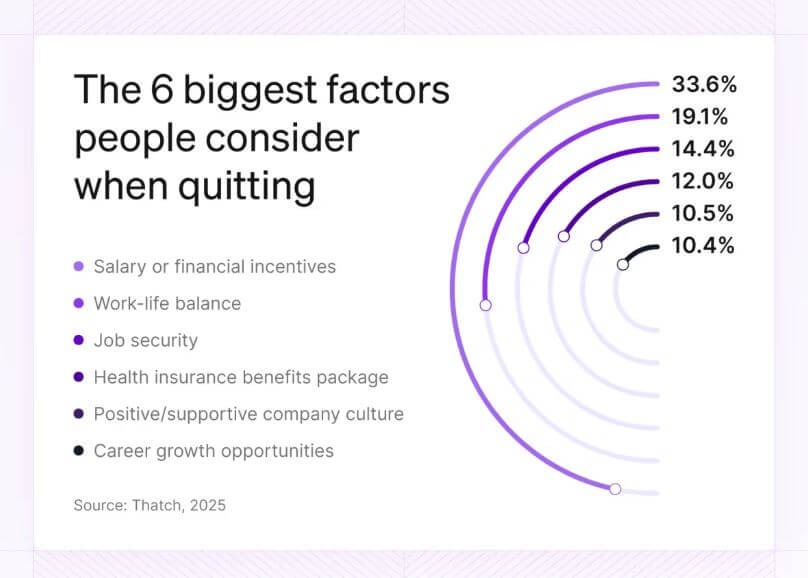
It is unusual for someone to quit their job for only one reason. In Europe, high compensation is generally a factor; conversely, a significant number of job change reasons fall into other categories as well, such as: career progression, work life-balance, job security and the nature of the employment relationship, including in relation to management. Flexible workplaces, career opportunities, and good work place cultures also factor into where someone seeks to find or stay in a job.
The extent of role clarity, feedback to a team, recognition and any way you show your employees that you care, are very significant in retention and even a fully contented team member could be on notice if these things are lacking. Even in an existing staff member that is currently happy but these are absent an employee may at least know what to look out for if, or when, looking for their next challenge.
To find out exactly why people leave businesses do need to more than just measure an all-round turnover. They should utilize analytics to get insights into where, why and, particularly, to analyze how many people have voluntarily resigned during this period, break down turnover to departments and understand exactly which profiles are leaving and when and measure trends in departures based on salary, workload, career progression and other metrics, so that a true course of action can be taken rather than simply refilling open positions endlessly with ever disappearing staff.
What Is a Normal Employee Turnover Rate?
The employee turnover rate differs depending on the industry, region, location, type of roles and current labour market. Therefore, there is no single employee turnover rate that can be considered “normal” for every company.
In more stable sectors, an annual rate between 8% and 15% may be considered healthy.
However, industries such as hospitality and retail naturally experience much higher turnover because of seasonal work and temporary contracts, as you’ll find out in the next blog section.
Is a 30% Employee Turnover Rate Bad?
This question is a very common one, because companies want to understand better how they can improve their organizational culture, task divisions and employee satisfaction. They want to make sure they’re doing everything they can in order for their employees to feel good at the workplace.
Whether a 30% employee turnover rate is bad depends entirely on the industry context, role levels, and if departures are voluntary. While a 30% annual rate is not good for corporate tech or finance, it is close to normal for retail, hospitality, or manufacturing.
The percentage alone doesn’t tell you whether your company has a serious retention problem. Losing 30% of seasonal employees over one year is very different from losing 30% of experienced team members who are difficult to replace.
It’s also important to compare your employee turnover rate with previous years and industry benchmarks. This will help you learn whether the result is part of a wider industry pattern or connected to problems within your company.
A consistently high turnover percentage can also become expensive. Every departure may bring recruitment, onboarding and training expenses, alongside lost productivity. To understand the financial impact more clearly, take a look at the hidden costs of hiring employees.
How Can You Improve Your Employee Turnover Rate?
Once you understand your employee turnover rate, the next step is deciding what to do with that information. Set realistic retention goals, choose the areas that need the most attention and assign clear responsibility for each improvement. Instead of trying to change everything at once, begin with one or two priorities that could make the biggest difference for your employees and future hires. Review your turnover rates regularly to see whether your actions are working, and adjust your approach when needed.
Reducing employee turnover is not a one-time project. It's an ongoing process that should develop together with your people and your company.